


Private Lunar ESP: An Interview with Edgar Mitchell
Extraterrestrial, extrasensory
Fia Backström and Edgar Mitchell
Edgar Mitchell, an astronaut aboard Apollo 14, was the sixth man to walk on the surface of the moon. While on board the spacecraft, he conducted a series of private ESP experiments that had not been approved by NASA. On his return he founded the Noetic Institute of Sciences in northern California. Trained as a military test pilot, he holds a PhD in Aeronautics and Astronautics from MIT.
Fia Backström: How did it come about that you decided to do ESP experiments while on your mission?
Edgar Mitchell: It happened about three weeks before the mission. I met some research physicists, Drs. Boyle and Maxie, who were very interested in the field, and suggested to me that this would be an ideal time to do the experiment. They gathered and coordinated everything; I was too busy for that. In addition to the two of them, there was a reputable psychic that they knew, and Olof Jonsson, who was a well-known public psychic in Chicago. We practiced a few times with the principles before the flight. As far as we know, it doesn’t take any expertise at all, except relaxation and focus, and the ability of individuals to intuitively resonate with someone else.
Were you already interested in ESP?
Oh yes. I had a religious upbringing, and was always interested in science; the two seemed to have different answers, which bothered me. When the chance to go to the moon came up, it re-raised the questions about what kind of world we live in, because nobody had been outside the atmosphere. I had been reading the literature for several years and had become convinced. Science says it can’t work but laboratory experiments show that it does.
Why the interest in doing these experiments in space?
Because no one had ever done them at those distances. The question was whether the effect fell off with distance, and the answer is no. People had thought this, but no one had ever proved it at distances of hundreds of thousands of miles.
Was it difficult to hide the experiment from your colleagues?
There was nothing to hide. I conducted the experiment on my own time with my friends. It was really intended to be a very personal and private experiment. We had no intention to making it public. Olof Jonsson unfortunately told the press before we ever had a chance to look at the data. The media was a big problem, because they were biased against the experiment. Most people in the media don’t know anything about statistics and they wrote whatever that particular reporter or editor thought. When the media learned about the experiment, it lost its effectiveness, even though it was subsequently published in science journals.
Of course, one experiment doesn’t make anything change, but it did show that what had worked in the laboratory also worked in space with the same very positive results. Professionals in the fields thought it was very significant. In telepathy, space doesn’t matter. Now we understand this very well, and we have the science now to show exactly how it works. It has nothing to do with space and time. It is what we call non-local communication.
Could you explain how you set up the experiment?
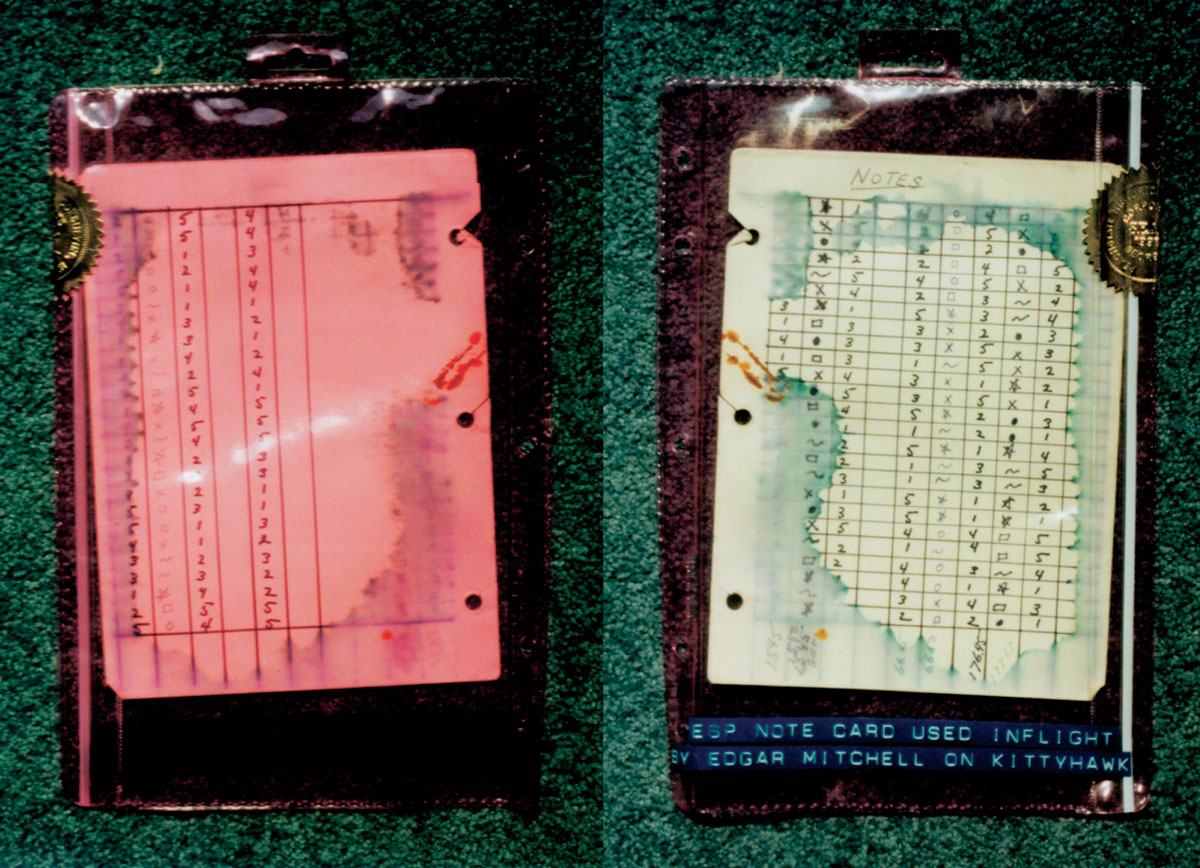
My experiment involved four transmission sessions during rest periods programmed into the flight. The well-known experiment in the laboratory was to use cards with the five Zener symbols, but the actual cards aren’t important. It was easier for me to use random number tables than carry the physical cards. Instead, all I did was to generate four tables of 25 random numbers just using the numbers 1 to 5. Then I randomly assigned a Zener symbol to each number. For each transmission, I would then check the particular table of random numbers and think about the corresponding symbol for 15 seconds. Each transmission took about 6 minutes. I did this when I was ready to go to sleep at night. We had sleeping bag hammocks that we would put underneath the couches. Two of us would go to sleep in a hammock while the other one would be on watch. I would do the experiment before going into my sleeping bag.
How were you able to coordinate with the people on earth?
We didn’t. We tried to coordinate but we were off. That didn’t seem to make any difference. We took off forty minutes late but I didn’t try for an exact time anyway, just in the evening. We now understand why that should work, because the sequence is important but having the precise time is not.
Were your colleagues at NASA suspicious when you returned?
Everything proceeded normally. I later became a standby pilot for Apollo 16, and retired from NASA in 1972. The reaction at NASA was very, very minimal! Except for Wernher von Braun and quite a few engineers, NASA management ignored the experiments. Many people came to my office and closed the door and wanted me to tell them about it, which I did. Nobody else said a thing.
Wernher was very intrigued by it and was very supportive. He wanted me to do a survey of NASA installations to see if there was any place that would be useful and appropriate for us to do some more of this work, to further these studies in a deeper way. But we both left NASA before we ever got that really accomplished. He also came and spoke at a fundraising dinner for the Institute of Noetic Sciences.
When you came back, did you become a media personality because of the experiments or because you were an astronaut who had come back from the moon?
A certain segment of people were truly interested in questions of mind and consciousness and spiritual matters and so forth. There were really two constituencies, like there always have been.
How did your voyage to the moon change your life?
After the work was done, when we were coming home, I had time to contemplate. The spacecraft was working well. I could look out the window for three days and enjoy it. I had a non-local feeling that there is something here I don’t understand even though I know about galactic formation, how the stars and elements were formed, and so on. I felt a part of it. It was my molecules; it was real, abstract, sensation. That insight set the tone for my last 30 years. I had to understand what kind of a brain is it that allows me to experience this. So I came back and started studying the mystical traditions, Uri Geller, and the inner religious experiences of humans. Because of my epiphany in space, I have come back and spent 30 years trying to explain what mind-brain is.
How did you meet Uri Geller?
The gentleman who was originally doing work with him, Dr. Andrija Puharich, called me and asked me if I was interested in meeting him. Geller has been investigated many times all over the world by scientists and magicians who are trying to debunk him. You have to work with these people on their terms. You find out what their shtick is, so to speak, and you set up a science protocol that works within the parameters that they are comfortable with. We did not set up a controlled experiment to do teleportation, for example. We didn’t really know how to do that.
But you did ask him if he could teleport a camera you forgot on the moon?
That was really more of a joke, because I was annoyed with him. We were trying to get work done in the laboratory, and it wasn’t working, and Geller said that he was good with teleportation. So I said “OK, teleport back the camera I left on the moon.” He didn’t get the camera back but he did get two lost tiepins of mine back. A piece of one of them showed up in Geller’s mouth as he was eating ice cream, to the surprise of all of us. The other tiepin and the rest of the first one then showed up in the laboratory. One piece turned up right in front of Dr. Puthoff when he was with a group of people, and the other dropped to the floor between Dr. Puthoff and me when we were in the laboratory alone.
What is your most important current project?
My biggest work is developing further the understanding of the quantum hologram and how it works in relation to the brain. The real enigma we don’t have a handle on yet is the psychokinetic effect. It has to do with intentionality and the quantum hologram, but exactly how that functions physically is not obvious to us. The perception of non-local information like ESP is easy to explain through the quantum hologram; you are just picking up the information from another person. Telepathy is just information coming in; psychokinesis, just information going out. But the material deformation of things is a little more mysterious. It takes energy to bend a ring. We can understand healing; you are a sick person, and I give you the information and your body heals itself. But how to move a ring is a different problem. The universe and the experiences within it arise from natural causes. The remainder of the problem, of consciousness, that is, is to look for the evidence from modern science that points the way to reality. Eventually we will be able to explain it all, because it is natural, not super-natural. It’s just our ignorance that causes it to seem supernatural.
What is the quantum hologram?
The concept of the quantum hologram is based on quantum emissions from all physical objects, you, me, the camera. Any physical object of macroscopic size, molecular and above, emits quanta of energy and absorbs quanta of energy. The quanta emitted from every object we’ve discovered carries information about the physical. The quantum hologram is this informational structure about a physical object and it is non-local, which means it is not space-time restricted. It appears to be a proper mechanism for explaining virtually all of these types of psychic manifestation that we humans know. We are now beginning to understand what consciousness is, and what we understand so far is that the quantum holographic record survives. It is our history, it records our passage, it records what we do, and it’s available to the future. It appears to be nature’s way of preserving our experience; that’s the non-local part. It’s the informational part of us, so that everything we do as physical beings is recorded in the ephemeral quantum holographic record, the giant hard disc in the sky, if you will.
Edgar Mitchell was a NASA astronaut and the lunar module pilot for Apollo 14. He holds a PhD in aeronautics/astronautics from MIT and is the founder of the Institute of Noetic Sciences.
Fia Backström is an artist based in New York.
Spotted an error? Email us at corrections at cabinetmagazine dot org.
If you’ve enjoyed the free articles that we offer on our site, please consider subscribing to our nonprofit magazine, which includes unlimited access to all our archives.