In southeastern Turkey, the archaeology of the checkpoint
Xurban Collective
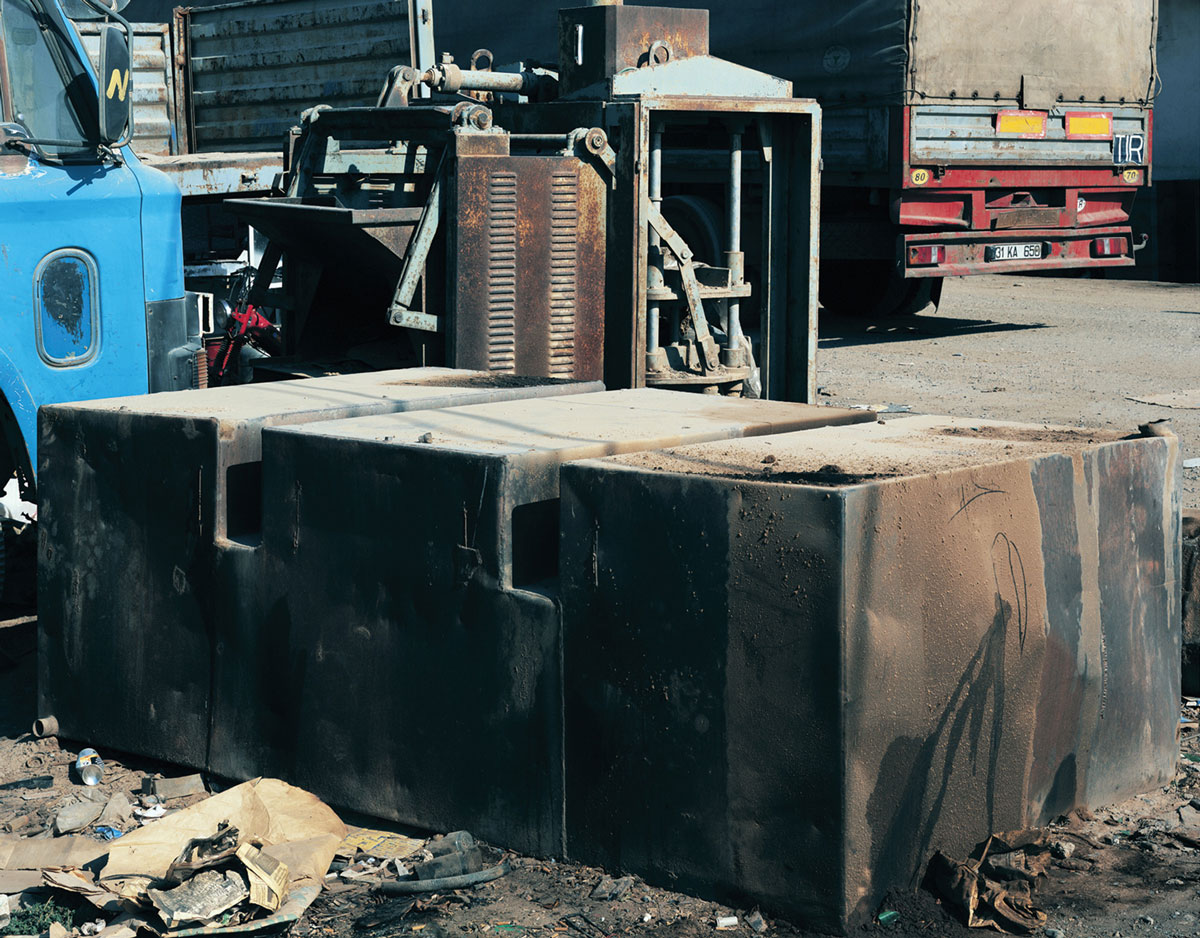
The Container as it was found in Kiziltepe near the city of Mardin, 7 August 2003. The Container was brought to Istanbul and exhibited as part of this project.
WAR PAST, WAR PRESENT
The civil war between the PKK (Kurdistan Workers’ Party) and the Turkish armed forces in Southeast Turkey has been one of the most crucial trials for the structural integrity of the centralized Turkish nation state. To silence the PKK, the armed forces opposed the guerrilla threat to its full extent.To secure the region, the State established temporary partnerships between feudal and religious groups, non-cooperating villages were evacuated and burned, and scores of people were forced into exile. And to “eliminate distractive voices,” politicians and writers have been imprisoned. Consequently, the brutal military engagement generated more support for the PKK among the local population, and in return, the military used more force; the conflict claimed more than 30,000 deaths (mostly Kurds) over its 20-year history.
Through militarization, the region itself was transformed into a containment zone. For us, the principal sign
of containment appears as “the checkpoint,” where the flows (of bodies/language/expressions in general) are controlled and made possible within the defined territory. Militarization acts within the closed system of exchange, among elements of a contained zone. If the violence rages within, it is opposed by armed force to all extent. Language is constrained to hold back the possibility of expression, while regional trade is
left free to flow to maintain equilibrium. The nature of the containment becomes that of a curfew, a self-imposed
martial law of the civilian rule; the routes of trade facilitate the existence of checkpoints.
Although the southeast of Turkey—the region bordering Syria, Iraq, and Iran—long had the distinction of being a “high alert zone,” extreme militarization and containment of the area through checkpoints apparently eased in recent years, while across the border the occupation of Iraq (and also,
of Palestine) is going on full force. Today, the militarization and privatization of Iraq’s resources is confronted with increasing resistance. The irony of this is that the US totally misinterpreted the socio-historical conditions in Iraq—a
failure we register as a paradoxical triumph for people who strongly argued against the war.
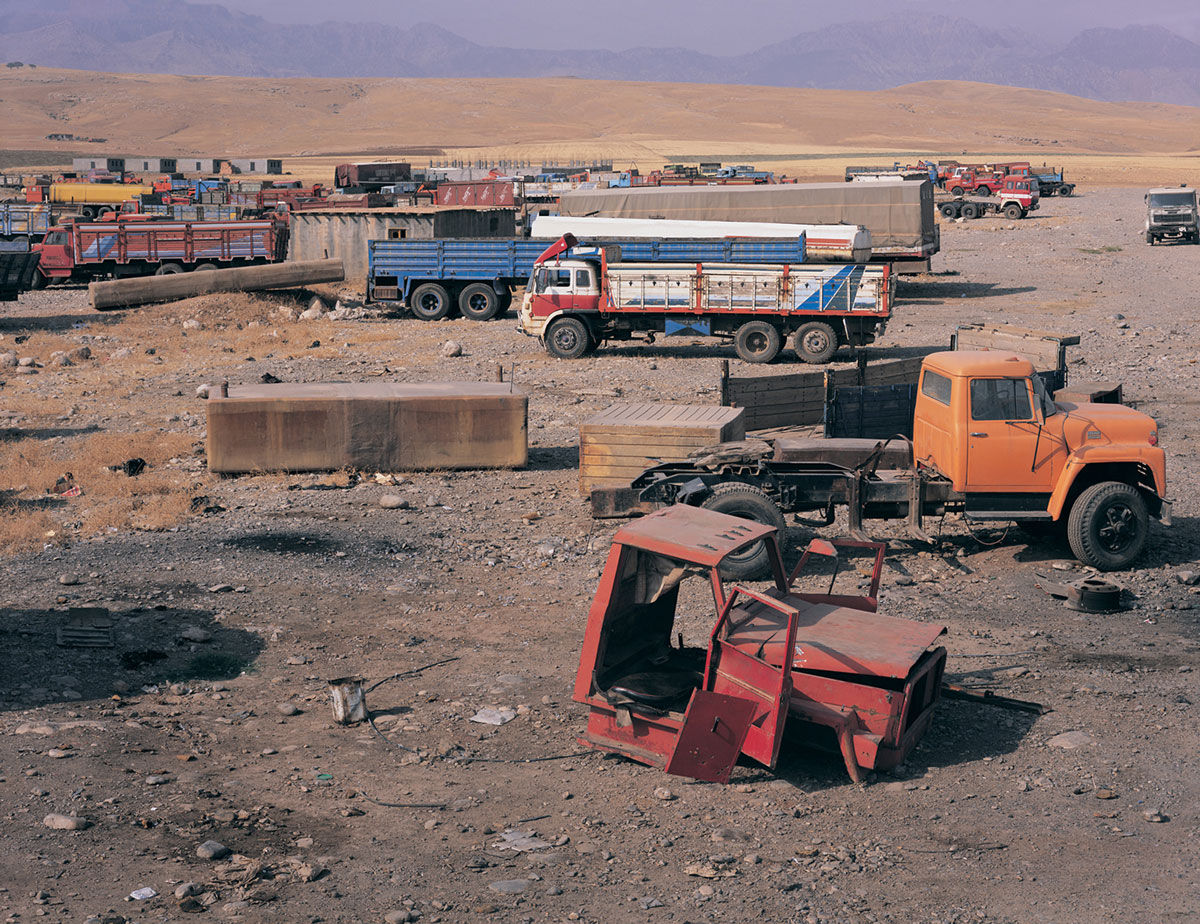
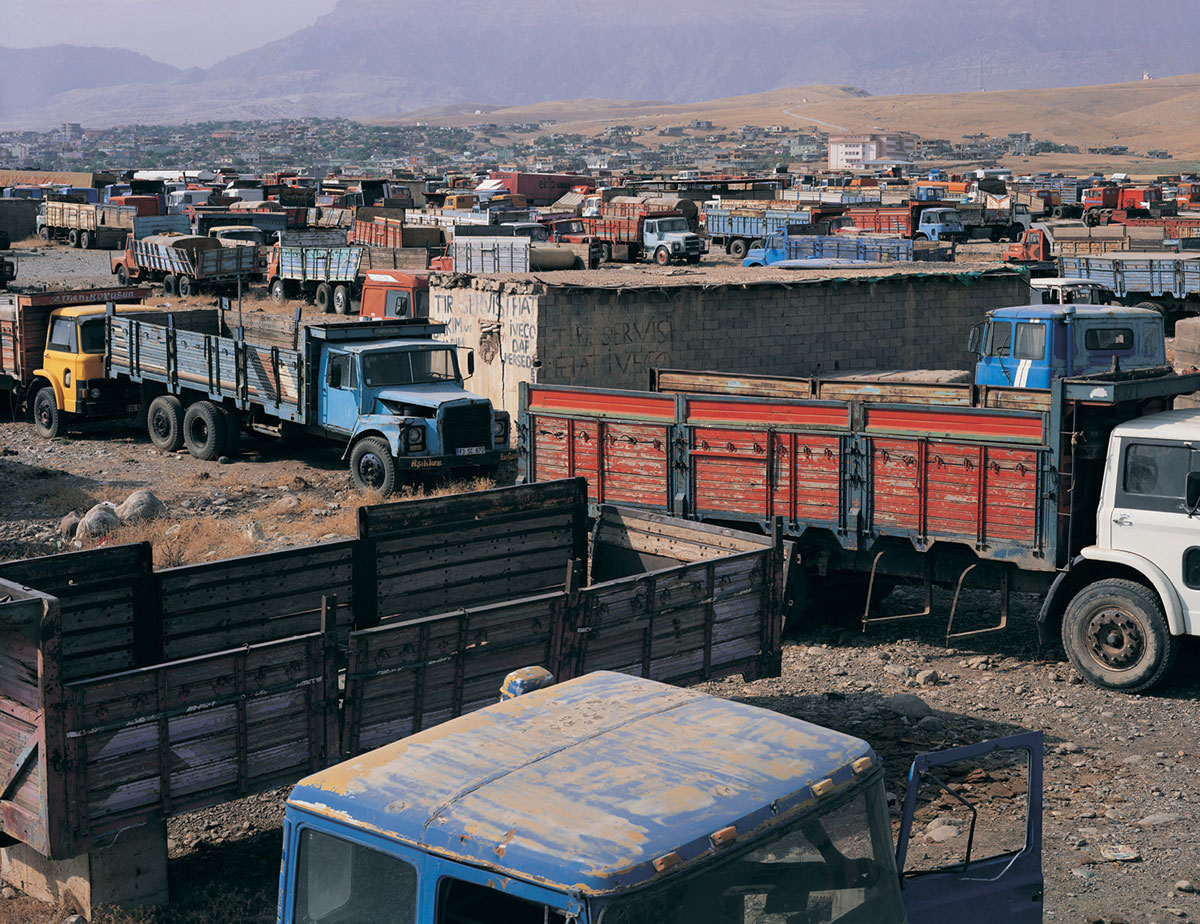
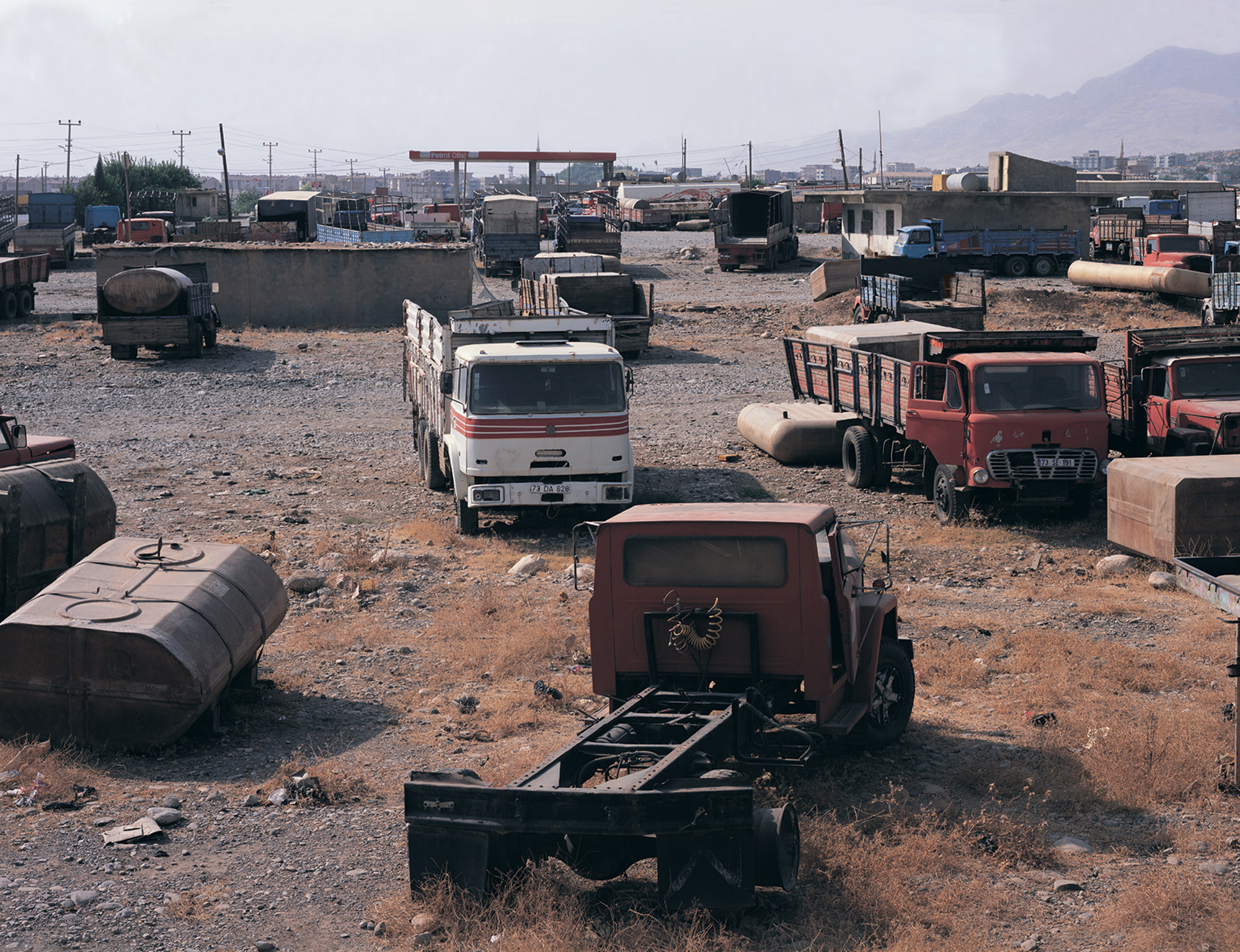
Dumping ground at Turkey-Iraq border on the outskirts of Silopi near Sirnak, 9 August 2003. Although UN sanctions against Iraq placed heavy regulations on trade, the Turkish government turned a blind eye to these limitations and passively encouraged open trade between the two countries. In addition, almost all of the trucks transported goods across the border were equipped with special steel containers (custom built to fit underneath trucks) used for off-the-books transportation of diesel fuel back into Turkey. In part, because of the UN pressure, the Turkish government finally began to monitor this activity. Outlawed and useless, thousands of containers are now sprawled along the highways as the remnants of a once prosperous barter economy of sorts.
THE PROJECTILE
The archaeological strata of the political-circumstantial
evidence tend to fuse into one another as one travels
eastwards. The unrecorded histories of this fusion and
cycles of sedimentation (i.e., oppression/resistance) require the methods of field archaeology, of in situ observation
and excavation. Thus, instead of the structural differences
of art production between the Orient and the Occident
(or the center and the periphery), we concentrate on the observable side of archaeological layering: How layers
fuse into each other, and the possibilities of a kind of
observation that includes the members of the Xurban
Collective, whether living in the East or the West.
The project we realized for the 8th Istanbul Biennial in 2003,
titled “The Containment Contained” provides clues to our future field
of interest, as well as key issues to understand the current situation
in parts of the Middle East. For this, we have exhibited an extensive
record of a journey we made to Southeastern Anatolia, all the way to
the Iraqi border. The recording (photographs) was accompanied by a fuel
tank that we brought back from the border, a representative among
thousands sprawled around the area. They were once used for the
clandestine but halfway legal purpose of transferring diesel fuel from
northern Iraq to Turkey. Being a container of a prized substance, it
sparked for us a number of associations on the nature of “containment,”
that is, of territory, of bodies and populations, and of modes of
ordinary existence.
ARCHAEOLOGY
The “archaeology” we allude to in our working methods is designed to
use instances of the past to map an alternative history of a given
situation. Treating the fuel tank as an archaeological object evoked
vessels of all kinds that traveled back and forth in this region for
millennia. But what the mute objects of archaeology do not make
manifest has to be filled in, attributed. In most instances, a version
of history is projected unto the object and on the conditions of its
“unearthing” via the deliberate use of methods and intentions. Thus, we
consider the methods we employ as rhetorical devices used for the
purposes of subversion, rather than restitution. Archaeology makes
possible the alteration of the official history. As an example, any
student of Ottoman history (and by the same token of all empires) is
well aware that it was a time of periodic insurgency and
counterinsurgency, of containment. In this sense, the legends of the
revolt are sung for the heroic/romantic seekers of justice up on the
mountain (so dear to Anatolian folklore) as well as for entire nations
that were rebellious toward the Empire. With archaeological references,
we try to dig into probabilities other than the militarization and
containment of territories.
Xurban is a collective founded in 2000 by Güven Incirlioglu (pope) & Hakan
Topal (imam) and dedicated to provoking conversations on art and politics.
Working both online and offline, Xurban is currently based mainly in New York
and Istanbul. “The Containment Contained” project contributors include Ahmet
Atif Akin (pagan), Simge Göksoy (simg), Mahir M. Yavuz (haci), and Zeki Aslan.
Xurban most recently exhibited at ZKM, Karlsruhe. More information available
at www.xurban.net.
Spotted an error? Email us at corrections at cabinetmagazine dot org.
If you’ve enjoyed the free articles that we offer on our site, please consider subscribing to our nonprofit magazine, which includes unlimited access to all our archives.