


All About Lightning: An Interview with Martin Uman
Flashes and fulgurites
Brian Conley, Sina Najafi, and Martin Uman
Martin Uman leads the University of Florida’s Camp Blanding International Center for Lightning Research and Testing and is the chair of the University’s Department of Electrical and Computer Engineering. The Center is the only place in the world that artificially triggers lightning on a regular basis as part of its research. It is also renowned for its work on fulgurites, positive glass molds made by lightning as it goes through the ground and melts the silicon content of the soil in its path. Fulgurites are what brought us to Uman, but we also discussed Walter De Maria, Allan McCollum, and Sotheby’s.
Cabinet: What is the history of artificially triggered lightning?
Martin Uman: The business of artificially triggering lightning by firing rockets with trailing conducting wires into the air was pursued with some enthusiasm at the Kennedy Space Center during the 1980s. There was also some triggering done in Mexico and some in France. In fact, the French sort of invented the modern system in the 1980s. But in the early 90s, the Kennedy Space Center lost interest in the research.
The big impetus in the States for research into triggering lightning came from trying to understand why Apollo 12 in 1969 was struck by lightning at 5,000 feet and at 13,000 feet. The lightning singed off all of the temperature sensors on the vehicle, and it tripped all of the circuit breakers. They lost all power and were without their gyroscope. But in those days, rockets were hard-programmed to go into orbit. It just went up no matter what you burned up. When they got into orbit, they reset the gyroscopes, the circuit breakers, and checked out what they could. They decided that everything was okay, and they went on to land on the moon.
The problem right after the Apollo event was for NASA to explain how they didn’t know that the rocket was going to get struck by lightning. But it took several years for people to figure out that it wasn’t struck by lightning—it made the lightning. And that when big objects like airplanes and space vehicles get into a cloud, they distort the situation so that lightning is produced even if that cloud was not going to produce lightning by itself. And it turned out that if you triggered lightning and made it come down a wire, you could study its properties. So it was a whole new world.
Is the whole image of Ben Franklin and the kite a myth? Did he do lightning research?
He showed that there was electricity in thunderstorms. He flew the kite and sparks came off the bottom. He didn’t want the kite to be struck by lightning. In fact, if you put something up slowly into the atmosphere, it generally doesn’t trigger lightning. You have to get it up there in a hurry.
Real lightning research started in the 1880s when photography became possible. And in the 1920s and 30s, there were electromagnetic field measurements and higher-speed photography. All of the significant findings occurred after WWII when computers became available.
What role did photography have?
Have you ever looked at lightning? It flickers. Well, there are lots of waves of light going up and down that path that you see that give you the sense of flickering. And in order to resolve what was happening, people had to use what is called streak photography, where the different parts of the lightning event were recorded at different places on the film. Now they’re doing it with high-speed digital cameras.
Is the primary purpose of the research facility that you have there to investigate how lightning can be triggered artificially?
No, we know how to do that. There are two purposes. One is to study the physics of lightning that we make because it’s similar to natural lightning. The other is to study the effect of lightning on things. For instance, Florida Power and Light has built us a succession of power lines with different kinds of lightning protection. We let the lightning strike that and then we measure how the lightning arrestors are working.
The physics is to understand how lightning is generated in the cloud, how it strikes the ground, why it strikes, what it strikes, what are the currents in the electric and magnetic fields near the ground, and so on. The ground end is probably more important than the cloud end. If you want to stop the lightning, you have to understand the cloud end. If you want to prevent things from getting hit, then you have to understand the ground end.
Can you successfully stop lightning from being generated?
No.
Can you prevent certain things from being hit?
Lightning comes down out of the cloud randomly. And then when it gets within about fifty yards of the ground the electric field from the downward-coming charge makes the electric field so large at the ground that upward-going discharges leave all the sharp points such as tree tops and so on. And one of those meets the downward coming leader from the cloud. And that’s what determines what gets struck. And so what exactly makes the upward leader and how that gets started… that is the physics of what gets struck.
There’s an artist named Walter De Maria who made a piece called The Lightning Field back in 1977. It’s a gigantic grid of 400 steel spikes that average about 20 feet in height and have points at their tips. The design and title of The Lightning Field would seem to suggest that it’s supposed to attract lightning and many of the most widely circulated photographs of it include lightning strikes, but usually ones occurring in the distance rather than on the array itself. Do you have any thoughts on this?
Actually there’s a school of thought that thinks that such a configuration would mean there would be no lightning. My guess is that the strikes to that field would be exactly the same as the strikes to that same area without the poles because the lightning doesn’t know what’s on the ground until it gets 50 yards over the ground. If these spikes were much taller, over 50 yards, then it would make a difference. But only in attracting the lightning that would have hit the ground within about 100 yards of the edge of the array if the array were not there.
We know you helped artist Allan McCollum on a recent exhibition he did involving fulgurites. How did that connection come about?
Somehow he read about our fulgurite work and he contacted somebody at the museum at the University of South Florida who was interested in commissioning him to do something. He apparently somehow wanted to merge science with the random nature of art and make one of his installations of many similar things. A number of things he did were kind of “sciencey,” like the dinosaur footprints.
He was involved in the design of the experiment. We had made fulgurites out of zircon before—it’s a sort of a diamond substitute. And so we used that material and put it in a barrel and we built a special rocket launcher over the barrel. He was the one who fired the rocket because he wanted to be involved. We made a number of fulgurites until he found one that he liked. And when he found one that he liked, he went out and found somebody locally who was willing to make 10,000 of them in a similar kind of material.
What were the criteria for him liking that one?
He wanted it to have what he called terminal sacks at either end that came to a point. Other than that I don’t know what his aesthetics are. I like the ones that are open, myself, so that you can see in the ends. And he wanted them to be closed. Something about what the world is like at the end of time. He’s a really interesting guy.
What is the Center’s interest in fulgurites?
The way our interest in fulgurites started was that we were doing work for the Electric Power Research Institute and the issue was, how does lightning get to underground power cables? At that time people thought that when lightning hit the ground it would just spread out and maybe get to the underground power cables. It turns out that what happens, in Florida sand for example, is that it doesn’t spread out. It goes through the ground just like it goes through the air in a path that’s about an inch in diameter.
Is lightning always an inch in diameter?
Roughly. And when it goes into the ground, it just keeps going until it hits some conductor that can carry the current off—at least in soil like Florida soil.
How hot is that? Will it fry things underground as well as it goes through it?
Well, it certainly melts the sand. And then the sand re-solidifies as glass to form fulgurites.
Do you take these fulgurites and read their configuration in any particular way? Is there nothing about their shape that is informative to you?
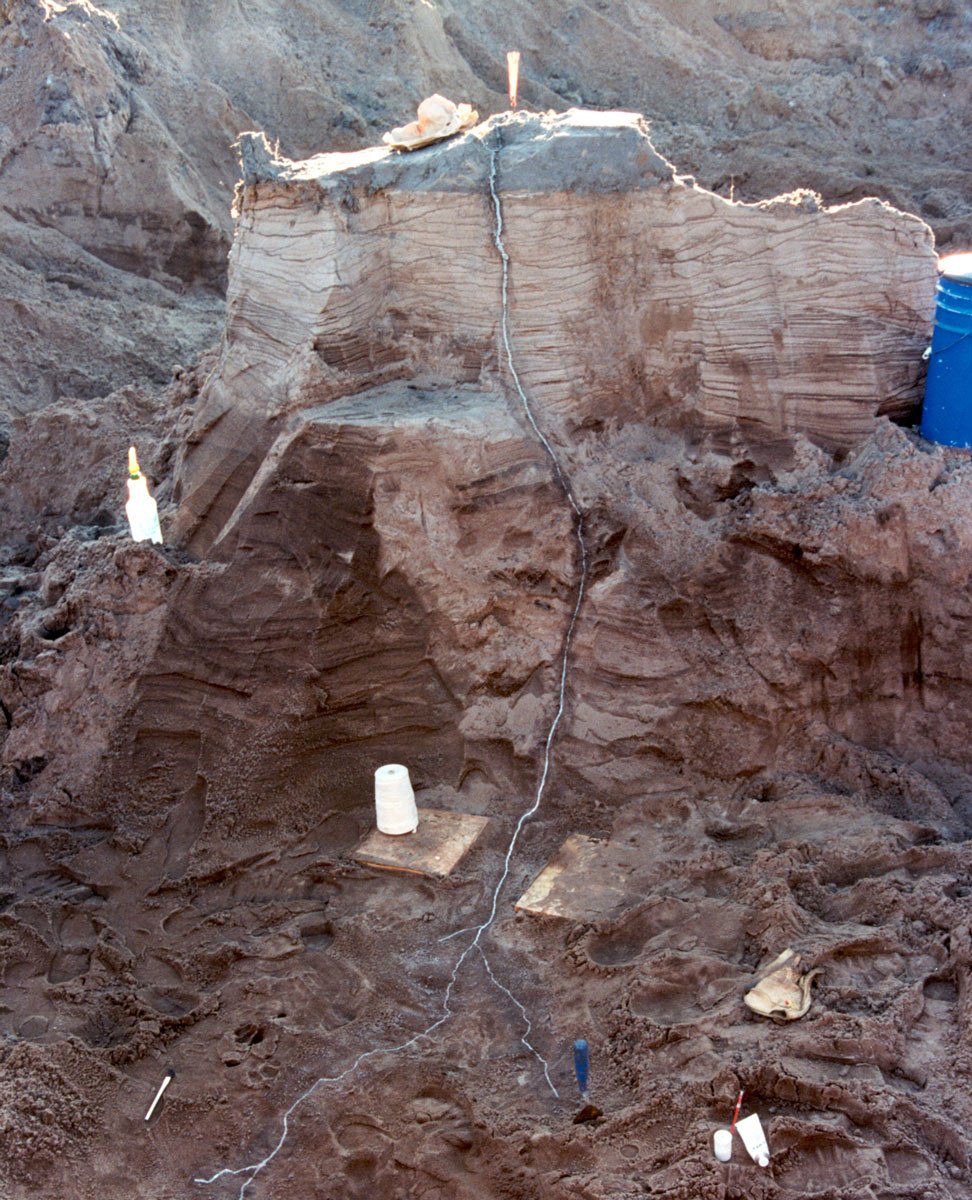
The important thing to us about fulgurites is the way the total lightning current entered the ground and entered a power cable. So we excavated a lot of the fulgurites going into underground power cables. The cables were badly damaged by the heat of the lightning. So the fulgurite actually goes right down to the underground power cable and then glass sand is sort of welded onto the hole that the fulgurite makes in the cable. The fulgurites therefore assumed a practical importance at least in the underground cable industry. There are reports of explosions in lines that are a couple of thousand feet below the surface with no connecting wires. So the issue is, can lightning travel a couple of thousand feet into the earth into an underground line and set off the gas? And the answer is, “Why not?” It goes through ten miles of air and the breakdown characteristics of soil are not much different than air.
Are many fulgurites the size of the one whose photograph you sent us?
Oh no. That’s the largest fulgurite on record. It’s in the Guinness Book of Records, actually. The reason that one stopped is because the water table is there and the current could flow into the water. So if you’ve got some place where it’s just pure sand for a long way and there’s not much water, it can go for a long way. And they’ll be branched just like they are in the air. It’s just hard to get the branches out.
So excavation is probably the most difficult part of the process.
Right. In fact, I think that’s why originally there were no long fulgurites around—because nobody previously had the skill to dig them out.
Is there a market for fulgurites?
Sotheby’s sold, I think, a nine-inch one for $5,000 in an auction.
What was special about that one?
I don’t know. I called the guy who was selling it. He said, “It is very beautiful.” You know about beauty, right? Some people think they know what it is. Most people are convinced by experts that they know what it is. They sold it in a gem exhibit. We have some 9- to12-inch ones that I’m sure are as beautiful as that one. Some fulgurites are really fat, and some are really skinny, and some have fat walls and some have thin walls. They’re all hollow. In my view what makes a fulgurite beautiful is that it’s big in diameter with a real shiny inside, and that the outside surface is fluted. It gets corrugated and then sometimes there are big flutes sticking out. And then there’s the color issue: depending on the sand, they can be more pinkish, or bluish, or grayish.
They’re sold on E-Bay from time to time. There are also a couple of web sites that sell them, including ours. A typical one-inch fulgurite sells for about $50. A 2- to 3-inch one may be $100. I would think that when you’re getting to 10-12 inches, it ought to be many hundred to a thousand dollars, because there just aren’t very many of those. And I would think our 17-footer ought to be worth a couple of million. But things are only worth what people are willing to pay for them.
Do you have a collection of fulgurites yourself?
Yes. We have one from the beach in Pensacola where the sand is pure quartz sand and you can see through it, whereas most of them are grayish and brown. A lot of them come from the Sahara desert. It was very thunderstormy there 10,000 years ago and apparently the lightning made very stable fulgurites. When the dunes that are there now shift, these 10,000-year-old fulgurites stick out. There are places in Texas and there are places in the Midwest where the same thing happens. Most of the world’s fulgurites that are for sale come from the Sahara. Most of ours are pretty fragile. If we don’t dig them out in a couple of months, the moles go down and burrow along the sides and make their own path and break the glass.
We hear that you’ve also directed triggered lightning to hit marbles and toys.
Yes, we just got amused and did some experiments. But what we’re really interested in is to make a diamond fulgurite.
How do you go about making a diamond fulgurite?
You put diamond dust in something at the right pressure. We haven’t tried it yet, and we’re not exactly sure what conditions are necessary. The pressures might not be high enough to keep a diamond. It might just turn to carbon. But nobody knows until you try it.
We think a diamond fulgurite would be worth a lot of money and it would support our research forever. Have you ever seen the Neiman Marcus catalogue? I think they had a 9- or 90-million-dollar submarine in there for Christmas. If we could make a diamond fulgurite, we would then let it be in the Neiman Marcus catalogue.
Fulgurites made by the Center for Lightning Research are available at www.fulgurites.com [link defunct—Eds.]. The revenues are used to fund the Center’s research.
Martin Uman is the chair of the Department of Electrical and Computer Engineering at the University of Florida and also leads the International Center for Lightning Research and Testing. He is the author of numerous books, including All About Lightning.
Brian Conley is an artist and senior editor of Cabinet and co-director of Immaterial Incorporated. He lives in New York City.
Sina Najafi is editor-in-chief of Cabinet and co-director of Immaterial Incorporated.
Spotted an error? Email us at corrections at cabinetmagazine dot org.
If you’ve enjoyed the free articles that we offer on our site, please consider subscribing to our nonprofit magazine. You get twelve online issues and unlimited access to all our archives.