


The Moral Storm: Henry Darger’s Book of Weather Reports
Henry Darger’s Book of Weather Reports
Lytle Shaw
He was right on the prediction of snow flurries and becoming very windy today, but the snow was very fine. He said little change in temperature but he was greatly wrong in that. It was 8 below, and 5 above was warmest. And he had said high in the 20s. He was right, though, on West to Northwest wind, but wrong on increasing to 18 to 28 miles per hour. It was between 30 and 40 miles per hour.
—Henry Darger, January 20, 1963
From December 31, 1957 until December 31, 1967, the artist and writer Henry Darger (1892–1973) kept a series of six ring-binder notebooks with almost daily entries on the weather in his native Chicago. On the outside cover of the first book, Darger describes the project, with encyclopedic enthusiasm, as a “book of weather reports on temperatures, fair cloudy to clear skies, snow, rain, or summer storms, and winter snows and big blizzards—also the low temperatures of severe cold waves and hot spells of summer.”
Though generally short, the entries abound in peculiarities. Darger is concerned, for instance, as much with periods of continuous temperature as with shifts—“3 to 7 am 57” (10/21/1958). Often up at 3am taking readings, Darger’s descriptive vocabulary also tends toward the moral and anthropomorphic: terms like “unsettled” and “threatening” are as common as “cool” or “hot.” Moreover, as the above epigraph suggests, the weatherman becomes a special figure. Darger’s notebooks can, in fact, frequently be read as an excruciatingly detailed moral account book of how well the weatherman was doing his job. The implications of this job (and Darger’s own self-imposed regulatory relation to it) come to take on a set of complex moral and allegorical senses. Nowhere is this more vivid than in Darger’s 15,000-page illustrated novel, In the Realms of the Unreal, where weather and its interpretation are crucial—at once quotidian and allegorical, scientific and divine.
As a preface to the epic struggle between the seven Vivian Girls and the satanic Glandelinians, the Realms begins with a climatic description of the edenic period in a province called Calverinia, where the Glandelinians will soon institute child slavery and thus bring about the wars with the Catholic nations in Darger’s world (1000 times the size of earth and with trillions of inhabitants): “There were never cold winters nor terrific windstorms nor anything to make people afraid.” But in the fashion of any good horror movie, such serenity serves only as a foil for the wild disruptions to follow. And it is precisely a storm that signals the end of this golden age. As in the Bible, then, part of the fall is a fall into weather, into atmosphere as mutable, and motivated by forces beyond one’s control.
Weather is humanized: a cloud can become “freakish in appearance,” and seem “to dissolve itself into something mysterious and fearful” attended by “sickening sulphurious smell in the air.” Moreover, his characters are weathermen. In one scene, after a 147-degree night in which the dogs howled continually, “Robert Vivian [father of the Vivian Girls] going near the beach of the southern sea shore, noticed a sudden change in atmosphere, and that the wind had changed to four directions in four minutes, then back to the south.” Equipped with internal barometers, Dargerian protagonists like Robert are especially perceptive of such shifts in atmospheric pressures. And they need to be, since climatic variations are Signs, Omens and Portents: “Ink-dark threatening clouds of fantastic colors and shape” spread “over the southwestern horizons, with amazing animation. Darker and darker became the ponderous globular avalanches of clouds, which though purple in color at first, became an inky hue or exactly looked like smoke, while a strange ominous booming roar was heard along the distant horizon in that direction.” Elsewhere Darger describes “clouds upon clouds that arose from a treacherous smudge along the rubbish under the snow, ignited by the fierce heat of the conflagration in the tree tops.” Terms like “inky” and “smudge” stand out, suggesting, perhaps, that while mechanically this particular firestorm may be almost impossible to imagine, Darger—positioned as both author and god—will have drawn it for us, and is now in part referring to his drawing.
That storms are often transparently linked to their graphic, moral creator does not, however, render them without impact. It is often precisely where Darger transcends or disrupts the vaguely plausible representation of weather that the most serious violence occurs: “Eddies of power and not wind, it seemed, grasped thousands of buildings and sent them careening into scattered piles of kindling.” Robert Vivian’s brother, Hanson, the Governor of Calverinia, loses his wife and daughter in the storms mentioned above. Nor does Robert escape unscathed: “I was literally blown out of my house and forced to turn some complete cartwheels, landed in a chicken house in a yard opposite my own home, which was torn to pieces, and its walls scattered about.” The force of the storm is compared to “missiles of a fierce and terrible invader.”
Despite such abuse, Darger’s characters seem to take pleasure in quasi-scientific meteorological classifications (and the occasions for inventing names afforded by them, which Darger rarely misses): “Robert noticed the action of the great typhoon clouds, and realized that it was a wild Spirian Tearian typhoon.” Darger and his characters also have a Poe-like interest in the transcendental aesthetics of natural disasters—“trees and meadows glowed with a weird and spectral green splendor.” Storms slow down the world, defamiliarizing the everyday, creating hallucinogenic dreamscapes: “Puffs of hot wind swept through the streets, and isolated heavy raindrops clattered like big hailstorms against the sides of the wooden houses, and made wet splotches on the sidewalk as big as a man’s head.”
Such strange, concrete images point to the world of Darger’s drawings, and to the larger ambitions of Realms. In some ways, Darger’s project can be imagined within the broadest tradition of Western religious painting: he wanted to make utterly palpable the moral universe he had invented. Realms was designed to overwhelm our senses. Narrative incidents were to be situated within complex atmospheres, so that drawings depicting violent struggles with the Glandelinians tend, for instance, to feature highly detailed, multi-colored inventories of foreground flowers, happy middle ground cottages and picket fences (jacked from coloring books), and tier upon tier of individualized cloud formations in the background, often complete with tentacles of lightning and foreboding black notches signaling oncoming storms. Even while tracing his clouds or collaging in conflagrations, Darger’s drawings seem to be reinventing a world with every line. Detailing dozens of escaping Calverinian girls navigating patches of burning forest during a firestorm, he seldom gets bored or generalizes.
And it is in this way that Darger’s pathological overtones, his obsessions, begin to place him in the elevated company of those painters who failed Western religious painting by allowing the need for palpable particularity, visualization, and atmosphere to overcome and obliterate the appropriate generality more frequently needed for the goals of moralizing narrative. By the early sixteenth century, the wealth of incident in medieval painting was seen, for instance, not only as messy and lacking in “realism,” but also as positively distracting from the biblical narratives to be inculcated. Even the pleasure in quotidian surfaces and complex compositions we find in late-fifteenth-century painting began to seem somehow beside the “point” in relation to the pared-down, psychologized works of Michelangelo and Raphael.
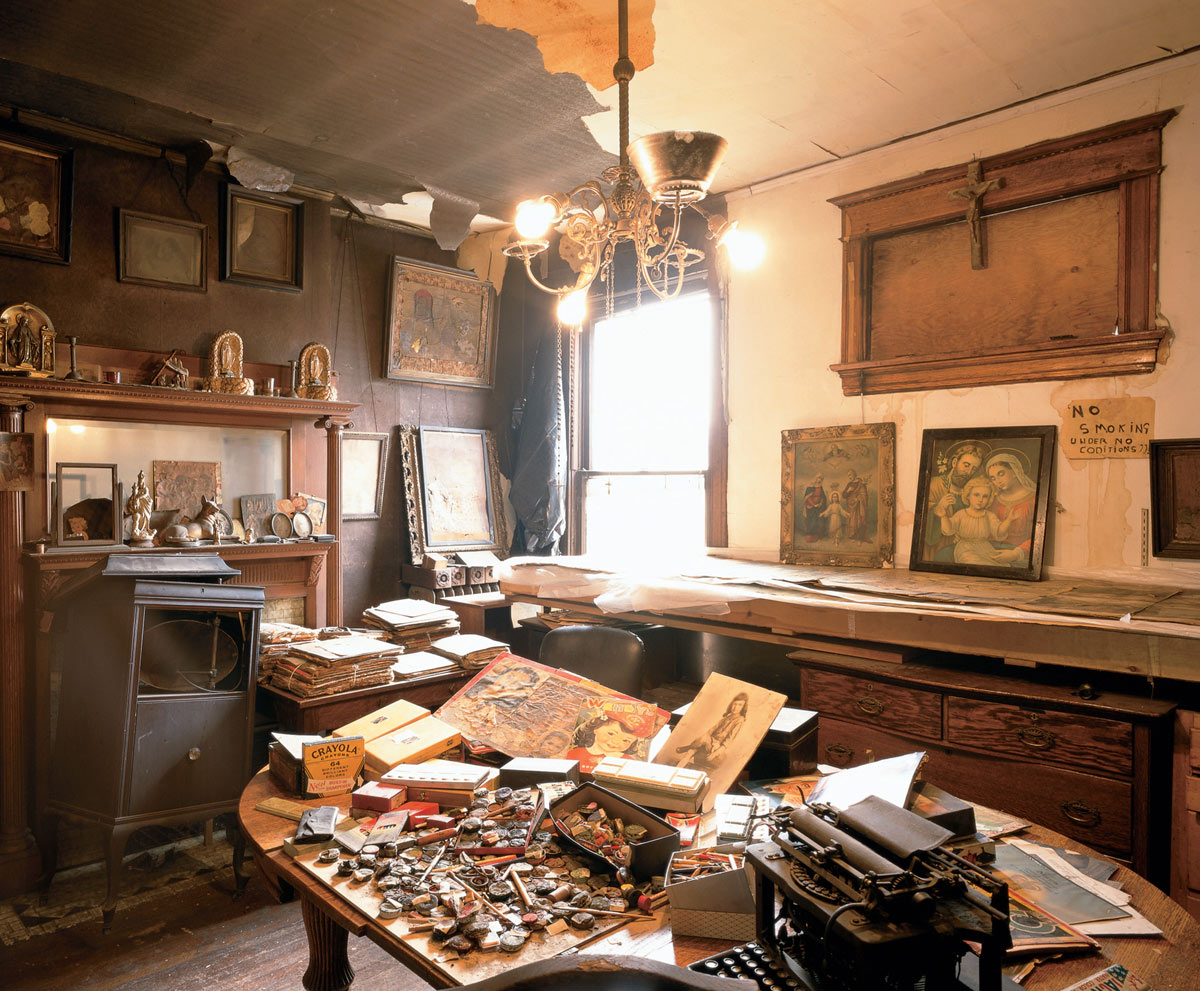
For Darger, moral anchoring points pop up now and again amid hundred-page descriptions of hurricanes, land battles and sweeping conflagrations: “Beautiful is the sun, which because of its wonderful splendor and radiance, was adored as a divine being by so many pagan nations. But more beautiful is the form of the Vivian Girls.” Realms is full of descriptions of characters breaking down when meeting, or even hearing about, the Vivian Girls. For most readers and viewers, though, it is this very gap between the simplistic moral rhetoric, a rhetoric of pathos and obligation, and the multivalent, pathological detail that makes Darger’s work so fascinating, and so disturbing. In “illustrating” his claims (I’m thinking here of his drawings, but one might make a related argument about his text), Darger invents a world whose psychotically proliferating detail—wearing outright its fascination with inventing new ways for grown-men marauders dressed in Civil War outfits to dismember little girls’ bodies—renders those very same claims intensely inadequate as an explanation of what one is presented with. This patient rendering of carnage is made all the more unsettling and bizarre by its placement within highly elaborated atmospheric and horticultural settings, which demonstrate Darger’s pleasure in cloud formations, lightning patterns, overflowing garden plots, happy diagrammatic houses, and verdant storybook hillsides.
One rationale for Reports may have been as a break from the imaginative demands of Realms. Though Darger probably did not cease work on Realms during the ten-year climatic inquiry, one suspects that his long periods at the typewriter and behind the drafting board were punctuated by hourly trips to monitor the atmospheric equipment at his window. But Reports was no casual hobby or diversion: Darger shaped it into what we might now call a conceptual art project, lasting exactly ten years and concluding with the word “finished.” It thus gives a kind of narrative to the weather. And if we see Realms as one kind of visualization, we might in turn imagine Reports as a complementary exercise, one offering complete immersion in climatic consciousness.
At first Darger does not abbreviate anything, as though the exercise of painstakingly writing out the month and all of the verbs and prepositions inside the weather notation would prolong the very state of awareness he seems to be after. Even when writing extremely short entries, he uses a kind of longhand—“Lowest 0. Highest nine above” (1/20/1958). Eventually this formal convention settles into “Low” and “High.”
Despite his interest in sensory data, Darger’s book is not exactly a rumination on one’s experience of the weather. Only occasionally do sentences describing “a minute fall of light rain and wet snow,” (5/4/1958) “slight streaks of clouds in the evening” (9/13/1958) or “traces of cirrus cloud” (6/4/1963) even begin to suggest this role. Such a consciousness emerges to some extent in Darger’s frequent mention of practical concerns—that it was “almost impossible to walk because of ice on streets and sidewalks because of rain” or that on the next day “you at least could walk the streets” (2/10/1959). But perhaps the most luminous aspect of the weather is the frequent enigmas it opens: “Partly cloudy to clearing. Very Strange haze in the sky. Moon looked yellow green in sky” (8/28/1958). On June 7th, 1959 Darger noted a “Strange mysterious haze in the sky.” The following day we learn that the “mysterious haze [is] still thicker.”
Darger’s attraction to such enigmas seems linked to his prominent use of the word “threatening” as a fixed position on the weather spectrum: for anyone who has read a description of a storm in Realms, “overcast to threatening” takes on ominous overtones: “Saturday August 23 1958. Partly cloudy to threatening in the afternoon. A few drops of rain.” One of the crucial differences between narratives that use weather and the weather itself, though, is that “threats” do not inevitably foreshadow dramatic events. One wonders, therefore, how Darger felt about the frequent near-misses he notes: “Thunderstorm passes even northwest. No rain here” (5/17/58); “Two thunderstorms pass by without hitting” (7/13/58); or: “Threatening but no rain after all” (7/20/58). Thunder tends to get registered through its volume: “quite loud thunder, but rain only a sprinkle” (5/5/1959). If each passing storm system presents a structure of expectation, so, of course, does each season. Darger’s seasonal expectations range from the mundanely descriptive—“warm out of season,” or “below normal temperatures for this month of July”—to the moralizing: “Fickle Chilly May ’Where the Season they call Spring?’ Eloped with old man Winter” (5/13/1959).
At the height of his enthusiasm for the project, Darger invents the monthly weather summary: “February was not so cold as January and had far less snow. But it was a bad month because it had two very bad freeze rains, and too much extremes of warm and cold. Very above normal warm weather between the cold. Fortunately no big snow storms so far this winter. How about this coming March?” Perhaps he sensed that the possible scales for such summaries were infinite, and retreated back to the day as a primary unit. In any case, the month summary of February 1959 seems to be the only one. It’s clear, however, that Darger did cross-reference and study his previous notations: “O worst storm since two years” he writes on June 25, 1959. And if one suspects this to be a casual, improvised claim, other observations suggest the breadth (and pathology) of Darger’s statistical cross-referencing: In January of 1963, Darger writes: “This was the first Friday we had at least two inches of snow. For all other Fridays since 1960 (no snow on these Fridays of 1959 until Friday Jan 11) extend back to 1959.”
The depth of Darger’s knowledge about his own project, and the character of his own retreat into the carefully fabricated world of his Chicago apartment, both suggest a strange relation to the tradition of Christian visualization and meditation, where withdrawal and focus are fundamental. Ignatius Loyola’s Spiritual Exercises, for instance, offered a structured visualization (administered by priests to subjects on a month-long retreat) of sin, the life and passion of Christ, and the afterlife. By withdrawing, “one separates oneself from many friends and acquaintances as well as from distracting business in order to serve and praise God Our Lord.” One’s mind is “not divided amongst many things” and thus one is more capable of “drawing near to and reaching our Creator and Lord,” and thereby receiving “graces and gifts from His divine and supreme Goodness.”
More than a little receptive to such gifts, Darger turns the complicating subtexts of this project into a life practice and a kind of treatise. Interested in this gap between a moral project and its materialization, Roland Barthes points to “the mass of desire which animates [Spiritual Exercises]. The immediate force of this desire is to be read in the very materiality of the objects whose representation Ignatius calls for: places in their precise, complete dimensions, characters in their costumes, their attitudes, their actions, their actual words.” For Darger, the Ignatian month becomes 60-odd years. Christ splinters into seven little girls. Fascination with materiality motivates not merely the elaborate detail of the Realms, but the simultaneous project of immersing himself in the particularity of the weather. The goal of being responsible for recording a decade of weather may suggest something of the obsessive nature of Reports. Barthes continues: “The obsessional character of the Exercises blazes forth in the accounting passion transmitted to the [subject who performs the spiritual exercises]: as soon as an object, intellectual or imaginary, appears, it is broken up, divided, numbered. The accountancy is obsessional not only because it is infinite, but above all because it engenders its own errors: being a matter of accounting for his sins ... the fact of accounting for them in a faulty way will in turn become an error that must be added on to the original list.”
The Book of Weather Reports is in fact concerned with a kind of endless, self-multiplying error; this error is not Darger’s, however, but the weatherman’s: “He was all wrong again except the temperature” (4/12/1966); “He says warmer at night. At 40? Yet it was 59 at 6am in the morning“ (9/25/1967); “Wrong in all predictions” (11/11/1966). Then there are the partially accurate days: “He said high in 50s. It was. He said north to northwest winds 15 to 25 miles per hour. It was northeast;” or: “He was right on mostly cloudy today and warmer”—before going on to point out discrepancies. In this way Darger’s relation to the weather does not play itself out within the typical Christian moral economy. If the weather is often seen as a rich source of Signs, these Signs have been taken, most commonly, to indicate Divine Wrath for human sin; to make one acquainted with the limitless extent of Divine Power; or to prepare one for one’s absolute powerlessness at the moment of Judgment. Atmospheric forebodings thus analogize both the limits of our agency and the inevitability of our mortality and final judgment. But none of these models quite describes what’s happening in Reports. Though practicing a literal retreat, Darger in some sense preserves his own autonomy by displacing the self-critical aspect of this retreat onto another figure. This pattern can be clarified by a look at Darger’s next project after Reports, his Diary: “Over cords falling down, angry temper spell with some blasphemies. Almost about to throw the ball at Christ statue. Blame me for my bad luck in things, I’m sorry to say so. I’ll always be this way, always was and I don’t give a damn” (4/7/1968). Darger’s minute, endless projects of sorting twine and cord give rise to explosions—threats to the icons in his room and curses directed at the saints and heaven—all of which he meticulously documents, but then seldom takes responsibility for: “Tantrums over difficulty with twine and cord. Defied heaven to make things worse. Threatened to throw a ball. And in spite of being at four masses today and communion. Yet I never stood for things going wrong all my life and under any conditions, no matter what the cost, never will” (4/10/1968).
What emerges in this diary is the mechanism, and the form, of spiritual notation without their (usually constitutive) belief in the absolute authority of heaven or the absolute depravity of the human subject. Though we see occasional contrition, assertions of immutable, defiant identity like those above are more common. As his 1959 New Year’s resolution, Darger writes in Reports, “I’ll do the same next year, as I did this year, and that is final.” Earlier, in fact, Darger had directly threatened God that if a favorite lost photograph were not returned, he would take it out on the Vivian Girls. The implication is that God is involved in but powerless over their struggle; he needs Darger to finish the account in the appropriate, moral manner. What emerges is a bizarre pattern of negotiations and displacements of what are typically bedrock givens in religious consciousness.
In Reports the serious work of anticipating and explaining the massive moral storms that punctuate Realms gets projected onto a kind of hour-to-hour calculus of Chicago’s climate—and, more importantly, onto the weatherman, in his role as official interpreter of this drama. Book three takes up the weatherman in its title, announcing itself as “Book three of the Weather Reports truthful or contrary of Weatherman’s reports.” The weatherman is the saint/intercessor who struggles with these daily predictions. His incompletion stems not merely from his innumerable failures, but from the way these failures might evaporate, were they not carefully preserved by another. Thus the weatherman also needs the figure of Darger himself checking and noting the atmosphere and temperature every few hours from his apartment. Darger’s regulatory office is not merely earthly, but divine. His project implies a fateful hour at which the sum of the weatherman’s predictions will be cross-referenced with Truth. In this scene of judgment, Darger will step forth dramatically and unveil his Book.
In June of 1958 Darger starts to separate days with a blank line. By the end of the journals, days tend to have their own pages. But the increased space tends to indicate not so much an increased attention to climatic particularities as much as an increasing desire to compare what happened with what the weatherman predicted. This movement from direct notation of the weather to a moralizing comparison of these notes with official predictions can be understood as a move from the quotidian and scientific toward the allegorical and divine. At times, even, we get only the predictions without what actually happened. Thus if seasons present structures of expectation that allow for a kind of moral disappointment, the weatherman’s predications focus this drama into a daily routine. In Realms, Darger is at once the faithful narrator of an infinitely segmented and complex Christian allegory, and a secret god, bursting through the surface of narration periodically to assert his absolute will.
Though Reports takes place in a continuous present tense, this same dynamic begins: from within the field of quotidian description, increasing consciousness of the moral and spiritual dilemmas posed by the weatherman’s activity comes to hijack the notebooks’ “scientific” aims, casting Darger as a special prosecutor whose binding judgments stem from his obsessively complete notations.
Cabinet wishes to thank the Museum of American Folk Art for giving Lytle Shaw access to Henry Darger’s Book of Weather Reports. The Reports will soon be part of the Henry Darger Study Center at the museum. The museum is also planning a large-scale exhibition of Darger’s paintings and writing in December 2001.
All Darger quotes are verbatim, including grammatical and typographical idiosyncracies.
Lytle Shaw co-edits Shark, a journal of poetics and art writing and curates the Line Reading Series at the Drawing Center.
Spotted an error? Email us at corrections at cabinetmagazine dot org.
If you’ve enjoyed the free articles that we offer on our site, please consider subscribing to our nonprofit magazine, which includes unlimited access to all our archives.