


Yesterday’s Forecasts: An Interview with James Rodger Fleming
You need a weatherman
Robin Veder and James Rodger Fleming
James Rodger Fleming is director and associate professor of science, technology, and society at Colby College in Waterville, Maine. He is the writer and editor of several works, including Meteorology in America, 1800–1870: Historical Perspectives on Climate Change, and Weathering the Storm, a forthcoming edition of the memoirs of Sverre Pettersen, one of the meteorologists who predicted the World War Two D-Day forecast. Robin Veder spoke with Fleming by phone about the history of atmospheric instruments, storm analysis, forecasting, and weather warfare in the US.
Robin Veder: What was the nineteenth-century American storm controversy?
James Rodger Fleming: In the mid-1800s, there were a number of Americans interested in what you might call the natural history of east coast storm tracks: Where do storms go, and what are they? When Joseph Henry needed to write a plan for the new Smithsonian Institution in 1846, he referred to the “problem of American storms.” The basic problem was, how do you name them? The term “hurricane” was not specifically used just for Atlantic storms back in those days. A tornado might, by some people, also be called a hurricane.
So Henry and his colleagues created a taxonomy of storms?
A taxonomy, that’s a good way to put it. It was closely related to field observation. When a tornado went through New Brunswick, New Jersey in 1835, they called it the “Brunswick Spout” because it went across the river and they considered it a waterspout at some point. Everybody who was anybody—the whole Who’s Who of American science, Alexander Dallas Bache, Joseph Henry, James Espy, Robert Hare, Walter Johnson, and William Redfield—went out with compasses and surveyor’s chains to measure the damage after the fact. They tried to figure out if the winds rushed inward, were they spinning, where did the storm hit, and what was the storm’s phenomenology. Everybody then published a short paper in the scientific journals, so there’s quite a rich literature on early American tornadoes.
Were they in agreement about what had happened?
There were three main theories. William Redfield, the amateur who chaired the first AAAS [American Association of Atmospheric Science] meetings, was mostly interested in the rotating effects of storms. He had seen hurricanes that had knocked down large forest tracts in Connecticut and, apparently, they formed a circular pattern, so Redfield thought that storms were whirlwinds. James Espy, a teacher in Philadelphia, was convinced that tornadoes were something like thunderstorms where the heat builds up, the moisture causes convection, and there are in-rushing winds coming to the center. Then Robert Hare, who was an electrochemist, thought that the real cause was the build-up and release of static electricity in the atmosphere. So there was a mechanical theory of winds moving in a circular direction, a steam version, and an electrical theory of storms. These three theories in the late 1830s through 1840s really defined the American Storm Controversy.
This set of interpretations led Joseph Henry to believe that what we need is a Smithsonian meteorological project that can encompass the settled part of the country. It would provide standard instruments as well as a center for correspondence. About 1848, they issued a set of circulars around the US telling people what and when to observe, and to mail their results back to the Smithsonian.
There must have been incredible problems with standardization. Did the Smithsonian go out and train people how to conduct observations?
The first person they hired was an itinerant worker; I call him a meteorological missionary. Arnold Guyot, who was new in this country, would go around with a standard barometer, and check the calibrations. The Smithsonian did hire a standard instrument maker, James Green of Baltimore, and they adopted a standard for their instruments. Of course, they ran out of money so they couldn’t give everybody these instruments.
Did the Smithsonian Institution observers become local authorities on weather?
Individual observers would. A fellow in Cincinnati, for example, would publish his notes in the local paper and then send them to Washington. Joseph Henry actually did develop expertise in meteorology and administered this large network that acted as the information-gathering source. But they weren’t collecting the kinds of data that could lead to solving this problem of American storms. They largely collected climatological statistics. So the intellectual issue raised by the storm controversy was never really resolved by the protagonists. The data they collected lent itself more towards settlement, agriculture, and long-term climatology than it did towards storm dynamics.
How did this evolve into our tendency to hold the meteorologist responsible for the weather? Meteorologists are often blamed or praised for their predictions, as though they are some kind of deity.
I think that the public’s perception of the science of meteorology is often formed by a public pronouncement. In the 19th century, observers would post forecasts at train stations, and eventually they found their way into the newspaper. Now we have radio and TV broadcasting and Net-casting on the Web. These people, typically, are communications specialists, not atmospheric scientists. They deal with a public that’s interested in whether you need a coat or an umbrella, or whether your picnic’s going to be okay. The public’s not much interested in the principles of the general circulation, and the behavior of a particular tropical storm and its inner workings.
August Schmauss, a German experimental meteorologist and climatologist, said, “A certain tragedy for meteorology will always lie in the fact that what it knows precisely is of interest only to a small part of humanity, while on the other hand, humanity’s interest is mainly in those processes which we can approach only with an uncertain degree of probability.” A nuclear physicist understands the energy generated in a reactor, but he’s not going to go on TV and say which atom is going to decay next according to radioactive theory. The meteorologist understands the earth’s energy budget and understands the dynamics of storms and understands the principles that apply to the weather, but the research meteorologists or the atmospheric scientists aren’t too excited about going on TV and saying we’re going to have twelve to eighteen inches of snow, because that variation depends on very minor adjustments.
TV meteorologists have recently pulled back a little on some of their predictions. They show what’s called now-casting instead of forecasting. They show you the picture of the current radar and the current satellite, then they make a modest prediction for the near future. When they try to do long-term forecasting for specific regions, it’s very difficult. The irony is that that’s exactly what Sverre Pettersen needed to do for the English Channel for D-day. He needed to make a long enough forecast that would allow Eisenhower to get the troops across the Channel and onto the beaches.
Was Pettersen able to do that?
There was a team of six forecasters from three different outfits communicating by phone to a coordinator in London. I believe that if we had followed their original advice—given that on June 5th the chop in the English Channel was so high that some of the landing crafts might not have made it—it could have been a disaster. Pettersen was gloomy about the whole thing, and held out until June 6th. There’s good reason to think that he actually picked the right day.
As it turns out, the Germans had been looking at the same weather, and had well-developed forecasting techniques, too. The German meteorological outfits thought the weather was too bad for any invasion. But Pettersen and his group found a small break that allowed for the landing on the morning of June 6th. So, there’s a real need, in some cases, for specific local time-dependent forecasting, but when you do it for a whole broadcast region, or with minimal training, that colors the impression that people have of the whole enterprise, so people blame the bad weather on the forecaster.
At some point, the military also became involved in trying to control weather. Is this what led to the Treaty on Weather and Environmental Warfare in 1977?
There has always been some interest and hope that weather could be somewhat controlled. Even back in the 1850s, James Espy thought that if you just light big forest lots on fire you’ll cause a lot of heat and updraft and it will lead to showers downstream. So, there have been proposals to modify the weather throughout the 19th and early 20th centuries. In WWII, the chemist Irving Langmuir, who worked at General Electric Corporation, developed techniques for making smoke screens. GE got into the microphysics of clouds, and how to make suspended particulates for camouflage. So they learned how to make clouds.
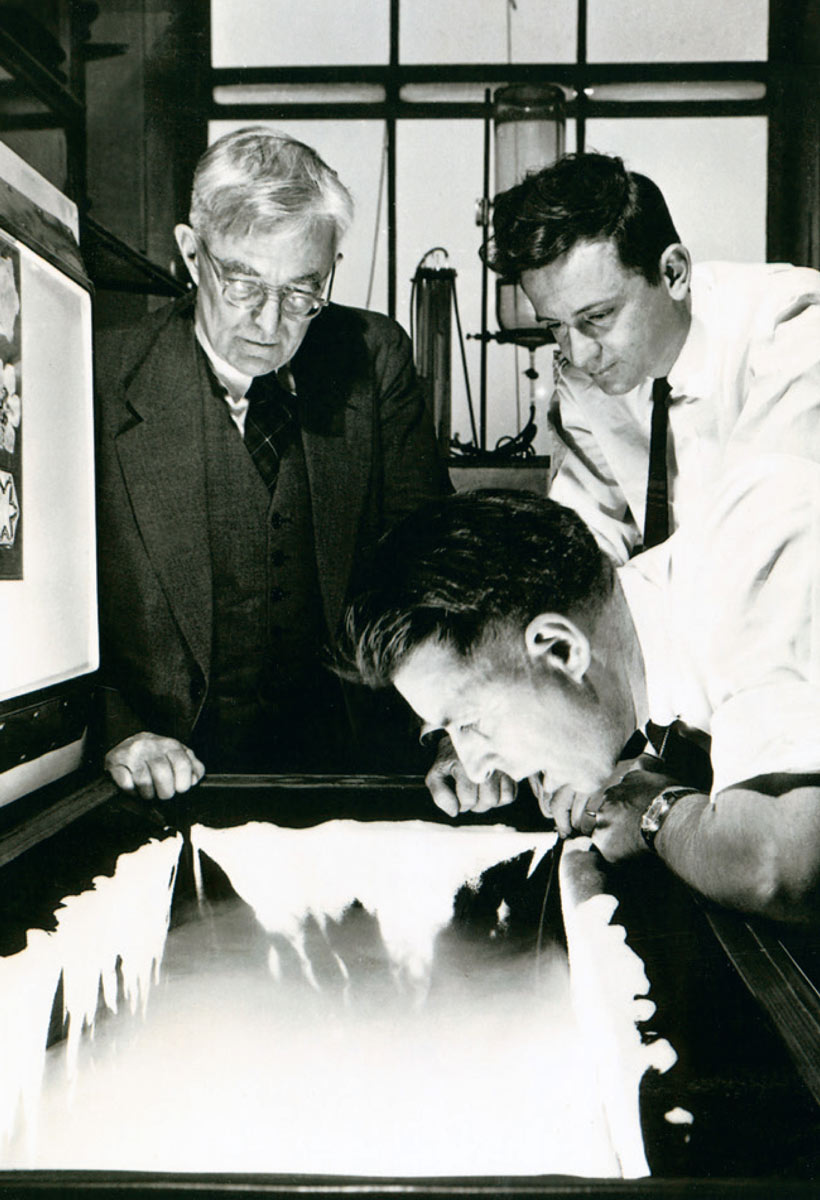
In 1947 Vincent Schaefer, who was working with Langmuir, dropped some crushed dry ice into a refrigerator with some water vapor in it. You know if you open a freezer and there’s fog inside of it? As he dropped the dry ice crystals in, he ended up clearing out the whole fog, so he learned how to clear out a hole in the clouds using carbon dioxide. The scientists took some dry ice up in an airplane and flew around in some clouds with a little grinder. They held it out the door, ground up some solid dry ice and cut a great big pattern in the cloud deck with their grinder. They knew they were onto something because they made it snow —or they thought that they had caused it to snow—by turning the super-cold water into ice crystals which stimulated the growth of snowflakes.
The third member of this General Electric group was Bernard Vonnegut, who was a chemist from MIT. He identified a chemical, silver iodide, which has a hexagonal structure, and since snowflakes are hexagonal, silver iodide serves as an ice nucleation site. When water vapor is deposited on silver iodide, it makes a hexagonal snow crystal. So GE had Langmuir, who’s a Nobel Prize winner, Schaefer, who had discovered the dry ice technique, and Vonnegut, who had the silver iodide. Vonnegut’s brother—Kurt Vonnegut—has written about this in some fiction.
“Ice-Nine” in Cat’s Cradle?
Right. Then the GE people started on their own; they went out and they caused it to snow over the Berkshires near Williamstown, Massachusetts. They claimed that they could do all sorts of things. They wanted to change the direction of hurricanes by dropping silver iodide in one sector and causing it to move into different directions.
The GE lawyers went ballistic. They felt that their liability was much greater than the possible benefits. If you caused it to snow from a cloud, maybe a city would sue you for the cost of snow removal. The ski operators might complain that you stole their snow from their mountain downstream. Around 1948, there was a very excited announcement in the GE annual report that claimed maybe we can control the world’s weather. The following year, they were completely silent. The lawyers had clamped down on these guys. Langmuir appeared on the Dave Garroway show talking about making the desert blossom, and changing the course of hurricanes.
Was that the kind of thing that GE hoped would happen?
GE hoped that they would be able to make something they could patent, some process with which they could make money. If you could control the weather, you wouldn’t need to have the snow-making equipment at your ski resort. You could promise people the kind of weather that they wanted. There’s a very interesting social dimension to this: Would everybody want to have fair weekends? There’s a lot of fiction about weather control, and whether it’s a good thing or not.
Then the Air Force got involved. They said to GE, “We’ll let the scientists fly with us. We won’t let them do any experiments, but they can advise us.” So, Project Cirrus, which was the Air Force project, came in to see whether this might have military applications. Maybe they could get an all-weather air force out of it. They could clear out fogs, sock in enemy airports with bad weather. There were proposals to send thunderstorms across the NATO countries. The weather moves basically west to east, so if you could send the bad weather out of Germany towards the east, you could stop a tank invasion from the Warsaw bloc or Soviet bloc.
The weather could become a military operation in itself?
They thought they could fight with weather warfare. General George C. Kennedy, Commander of the Strategic Air Command Generals, thought that if you can control the weather, you can control the world. There was a weather modification race with the Russians, something like the missile gap. When Sputnik went up, one of the early satellites that followed was TIROS, which was a weather satellite. There was this notion of weather spy satellites in the sky that could give one of the fighting forces an advantage over the weather.
Apparently, the CIA did look into whether this was feasible in monsoonal climates like Vietnam. They did some experiments in India first, and then the Air Force flew some cloud-seeding missions over Laos, Cambodia, and Vietnam to try to make it rain on the Ho Chi Minh Trail, to stop infiltration by making it muddy. The Laotian government wasn’t even told that they were flying out of Laos with these cloud-seeding things.
Jack Anderson, the syndicated columnist, found out about this, and his story stimulated a congressional investigation that brought this to light in 1973-74. The Russians jumped on the issue, and brought it to the UN to really publicly embarrass the US. Ford agreed that the US should sign this treaty banning environmental weapons of war. There was a lot of environmental warfare that was covered by this treaty. Cloud seeding wasn’t the only problem. The US had used Agent Orange to defoliate the jungle. There was the Rome Plow, diesel tractors or bulldozers, that the “Jungle Eaters” used to clear the land. The US had bombed the irrigation system of North Vietnam; that was considered war against civilian food production.
Were the weather modification techniques also used for productive agricultural purposes?
Domestic cloud seeding got a boost in the 1940s. Lots of private companies promised to deliver rain to farmers experiencing drought, or increased snow pack for dry Western states in the mountains. There were any number of private companies out there with little planes and little silver iodide flares, trying to make it rain.
But the US military wanted to suppress as much domestic cloud seeding as possible because they wanted to have the techniques for themselves. Plus, they wanted to have a pure background of unmodified weather to do their military experiments on, so they were very militant in trying to slow down the domestic cloud seeding.
There must have been a lot of animosity between the farmers, the cloud seeders, and the military.
In my early days, I was on a project at the National Center for Atmospheric Research in Leadville, Colorado. We were looking at how storms work by flying around in a glider. We weren’t cloud seeding at all. One night we were called to the hangar because the glider had been sabotaged by some disgruntled farmers who thought we were stealing their rain. But the idea was that a glider doesn’t have an engine, so it wouldn’t disturb the cloud. We would let the glider get sucked up into a big thunderstorm that was building, and we would look at what was inside.
You were inside the storm?
We were inside the storm, in a glider.
Was that frightening?
Yes. That’s why I became a historian.
James Rodger Fleming is director and associate professor of science, technology, and society at Colby College in Waterville, Maine. He is the writer and editor of several works, including Meteorology in America, 1800–1870: Historical Perspectives on Climate Change.
Robin Veder is a historian and curator in Washington, DC. Her current projects include the histories of garden labor, genetic research, and bridges.
Spotted an error? Email us at corrections at cabinetmagazine dot org.
If you’ve enjoyed the free articles that we offer on our site, please consider subscribing to our nonprofit magazine, which includes unlimited access to all our archives.