


Hidden Talents
The camouflage paintings of Abbott Handerson Thayer
Emily Gephart
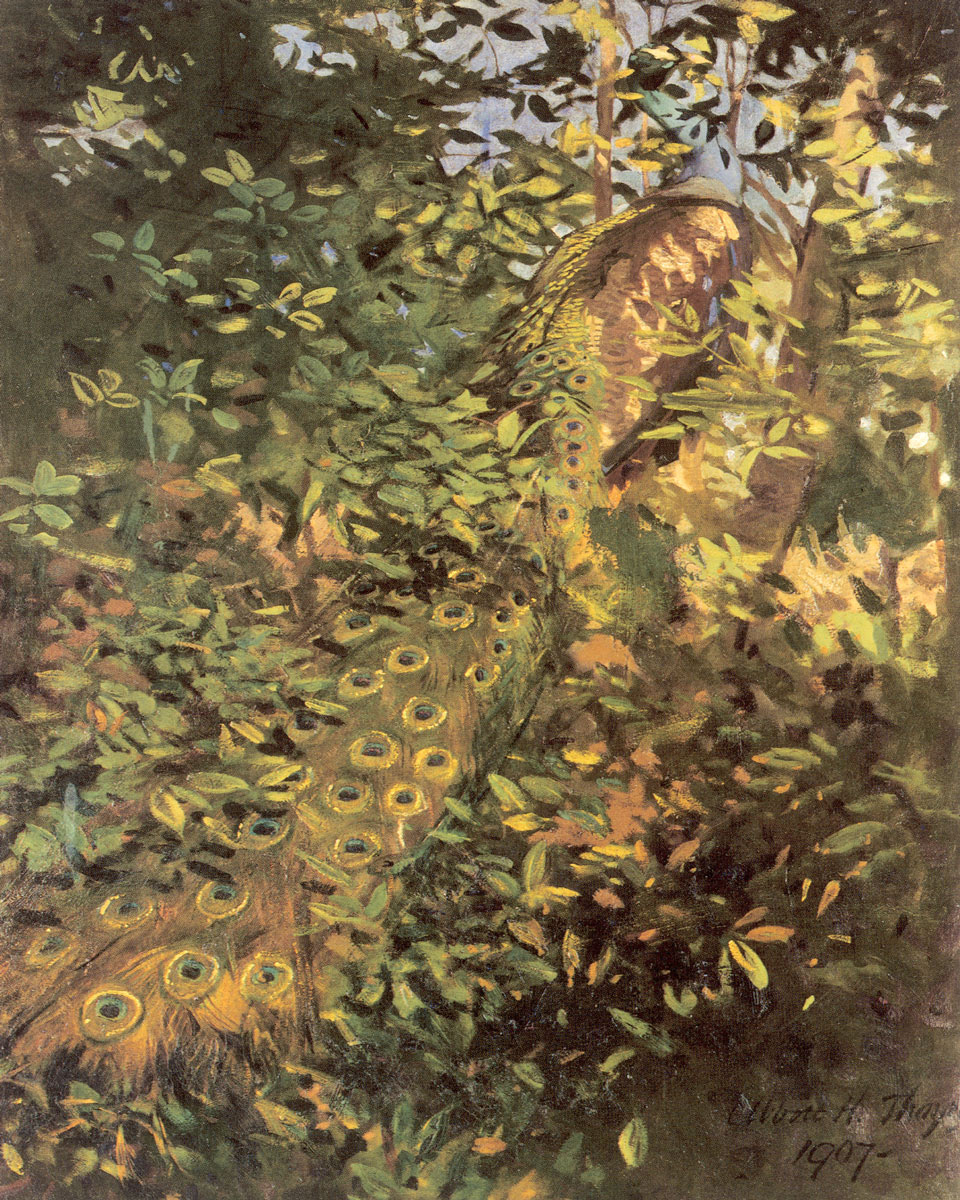
Combining a talent for observation, a knowledge of optics, and a love of natural history, the American painter and amateur naturalist Abbott Handerson Thayer (1849–1921) carved out a unique niche for himself in the space between the discourses of art and science.[1] Consider the paintings Peacock in the Woods and Red Flamingos, The Skies They Simulate, both dating from around 1909. These are two of the many images demonstrating animal coloration Thayer created with the assistance of his students and colleagues for publication in his book Concealing Coloration in the Animal Kingdom, An Exposition of the Laws of Disguise Through Color and Pattern: Being a Summary of Abbott H. Thayer’s Disclosures. These remarkable images illustrate Thayer’s belief that all animal coloration, regardless of its apparent visibility, was the result of the natural-selection process that allowed animals to go unnoticed by predators or prey. Despite the evident fallacy of this belief, Thayer made a significant contribution to the study of camouflage by describing and differentiating the ways in which animals conceal themselves.
A firm proponent of Darwinism, Thayer believed that the animal coloration he observed was the result of fundamental aspects of evolutionary development. Moreover, he believed that in the matter of animal camouflage, Nature was, in effect, acting as an artist, using color and light intentionally to create optical effects; Thayer equated Art and Nature as agents in the processes that had brought about evolutionary change. Thayer was by no means the first to observe that animals used their coloration to hide themselves in nature. However, in his groundbreaking article “The Law Which Underlies Protective Coloration,” written in 1896 for the American Ornithologists’ Union journal The Auk, Thayer elucidated the principles of counter-shading, whereby animals were made to appear “flat” by the use of graduated colors and tones of feathers, scales or fur. This counteracts the effects of sunlight and shadow, rendering an animal’s coloration darkest where it receives the greatest illumination, and lightest on the shadowy regions of its underside. The resultant reduction of the appearance of contour makes the animal seem to lose its volume and dimension. As a result of this optical illusion, “the spectator,” Thayer wrote, “seems to see right through the space really occupied by an opaque animal.”[2] Thayer’s first scientific article received widespread and justified praise. Using the lan-guage of art and optics, he had, for perhaps the first time, explained precisely why many animals seem to blend in with their surroundings. Thrilled by his success, Thayer followed this essay with others, increasingly supercilious in tone. In 1903, he extended his powers of observation to elucidate another principle of camouflage, the disruptive (he used the term “ruptive”) effects of patterned markings such as stripes or spots. These markings disguise an animal’s contours by making its contiguous parts seem unrelated to one another. This principle of concealment proved to be temptingly and dangerously elastic; virtually any kind of coloring and patterning could be argued to be “ruptive” under certain circumstances.
Despite his increasingly pompous attitude, at this stage Thayer willingly acknowledged that other scientists had reached similar conclusions and he retained an open mind about alternative forms of animal coloration. He commenced lecture-demonstrations, both in America and abroad, using illuminated shadowboxes containing sculptures, stuffed animals, and decoys to orchestrate elaborate performances of the principle of counter-shading. His enthusiasm frequently overwhelmed his audience: He vigorously encouraged observers at a 1910 lecture at the Smithsonian Institution to approximate the viewpoint of a predator by lying face-down on their stomachs, a request which the audience of ornithologists warily refused.[3]
A popular society artist and renowned figure painter in the 1880s and 1890s, Thayer had been a leader of the American Renaissance. He believed that his position as an accomplished artist and an observer of natural history made him uniquely qualified to understand and identify the principles of animal coloration. He wrote in 1903, “Nature has evolved actual art on the bodies of animals, and only an artist can read it.” Perhaps this degree of hubris was what led him to subsequently take his ideas to utterly absurd limits. In 1909, Thayer and his son Gerald published the book Concealing Coloration in the Animal Kingdom with illustrations provided by Thayer in collaboration with Gerald, his second wife Emma, and students Rockwell Kent and Richard Meryman. Black-and-white photographs were exhibited alongside paintings (reproduced in color) to demonstrate concealing camouflage in mammals, reptiles, birds, and insects.
The book, written primarily by Gerald, provided an exhaustive and valuable compendium of examples describing and demonstrating animal concealment. But the introduction written by Abbott professed a new level of arrogance. Thayer now claimed that all animal coloration, even the most flamboyant, served only to conceal the animal from detection. He boldly proclaimed, “All patterns and colors whatsoever of all animals that ever prey or are preyed upon are under certain normal circumstances obliterative.” The brightest coloration and patterning on an animal, such as that of a fluorescent flamingo or iridescent peacock, disrupts the animal’s form, by “destroying the apparent continuity of surface.” The eye of the observer, whether predator or prey, skips over the patterns and fails to see the hidden animal.
This is the reason why Thayer created such apparently ludicrous, although beautiful, paintings as Peacock in the Woods and Red Flamingos, The Skies They Simulate. Thayer submitted these images in his book as evidence that “ruptive” coloration could, under particular circumstances, serve to conceal even the most vivid animal. The scientific world reacted to Thayer’s now preposterous assertions with predictable skepticism and criticism. Former President Teddy Roosevelt, himself an amateur naturalist and world traveler, vigorously attacked Thayer’s beliefs in his own account of his African safaris, African Game Trails, and in a series of subsequent articles. Thayer’s reputation as a scientist suffered because of this heated debate, which lasted for several years and generated shrilly written defenses published in a number of magazines. However, it also secured the attention of the general reading public, which was not only fascinated by the scientific discourse but by the personalities of the individuals in contention.[4]
The stakes in the war of words over animal camouflage were enormously high for both Roosevelt and Thayer. Roosevelt, making his own bid for validity as an expert on natural history, ridiculed Thayer’s apparent belief that because an event could be imagined and subsequently depicted in art, it therefore must be fact. Thayer was indifferent to the charges that art could not be used as scientific proof, chastising Roosevelt and other non-believers because they did not put his ideas to the test. Indeed, Thayer felt that he and his fellow artists were uniquely capable of seeing beyond the limitations of scientific thought. Thayer repeatedly invited Roosevelt to visit his home for debate over the points of dispute, but Roosevelt refused.
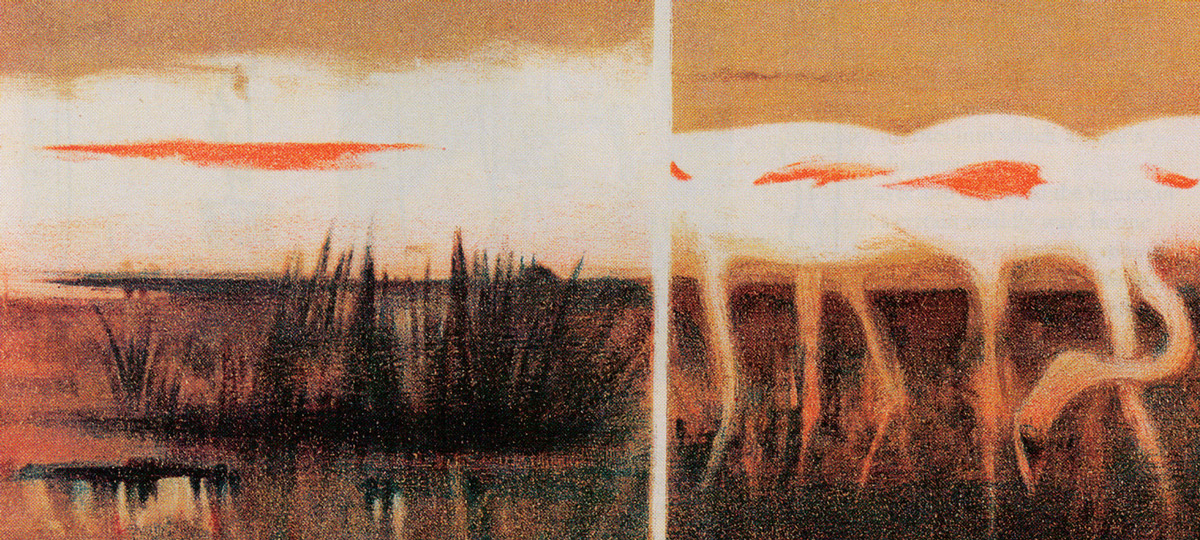
By this point, with so much of his fervent belief in the value of art to the pursuit of science on the line, Thayer was carried away by his own willful need to be right. The artist dismissed his increasingly vociferous critics and was regarded by many as a crackpot. What else would one be willing to claim of a man who, determined to vindicate himself, traveled to the West Indies, located a flock of flamingos at dusk, and lay down in the swamp to see whether they would “disappear” against the background of the setting sun from the perspective of a hungry alligator? Yet, despite these investigations, he failed to notice that flamingos are active during the whole day, are not preyed upon by alligators in saline ponds, and feed primarily on sightless organisms. Moreover, seen against the light of the sunset, a flamingo will not appear to blend in with it, but will stand out as a dark shadow against the sky.[5]
Thayer seems to have been stubbornly resistant to questioning and to contradictory evidence. He maintained that because an animal could be shown to disappear, this therefore indicated that at one evolutionarily crucial point it did. For his argument about concealing coloration and natural selection to be correct, he thought, he did not need to prove that every instance of animal coloration worked against any background. He merely needed to show that sometimes, against certain backgrounds and in certain conditions, his ideas did, in fact, work.
Thayer’s beliefs about disruptive patterning and coloration finally did find considerable practical use in the development of military camouflage. While the US government had been resistant at the turn of the century to Thayer’s exhortations that “ruptive” or “dazzle” camouflage could be useful in wartime, by the advent of World War I, they became a receptive audience. A special group of artists, designers, and carpenters designated Company A of the 40th Engineers was enlisted as the “Camouflage Corps” to study and implement the principles of concealing coloration. The group included several of Thayer’s colleagues, students, and friends. Thayer’s last article on the principles of camouflage was dedicated to elaborating the ways in which optical effects could be used by the Allied forces to confuse enemies on both land and sea. Thus, although not himself an active member of the team who developed military camouflage, Thayer’s beliefs about disruptive optics found both staunch support and pragmatic use.
Toward the end of his life, Thayer’s style of personality—the restlessly inquisitive, boundary-crossing, gentleman amateur—was out of favor. In American culture, his kind was increasingly replaced by specialized, Taylorized corporation men, who found their niche in society and remained there life-long. Thayer overstepped the bounds of his professional identity, attempting to be simultaneously an artist and scientist, amateur and professional. In the early twentieth century, America’s artistic tastes had irrevocably changed, and scientific professionalization increasingly discouraged the kinds of serious dabbling that Thayer felt was his greatest asset. Yet, as his career as an artist waned, Thayer had taken the risky step of following his passions, and ultimately is remembered as a truly original thinker. In today’s corporate climate, Thayer’s method of “thinking outside the box” seems both courageous and admirable. However, his example nevertheless reminds us about the dangers inherent in disciplinary “boundary crossing;” Thayer felt resistance to his ideas stemmed only from his status as an outsider, when in fact, his fierce determination to succeed as both a scientist and an artist, and his stubborn pride in his accomplishments, did not allow him to see the fallacies in some of his best ideas.
- For more on the artistic career of Thayer, see Nelson C. White, Abbott H. Thayer, Painter and Naturalist (Hartford: Connecticut Printers, 1951); and Ross Anderson, Abbott Handerson Thayer, exh. cat. (Syracuse, NY: Everson Museum, 1982). Art historian Alexander Nemerov presents an interesting view of Thayer’s obsession with camouflage in “Vanishing Americans: Abbott Thayer, Theodore Roosevelt and the Attraction of Camouflage,” American Art, vol. 11, no. 2 (Summer 1997). Nemerov suggests that Thayer’s preoccupation with invisibility was not limited to the natural world, but also reflected issues involving social ostentation and display prevalent in late-nineteenth-century American genteel culture.
- Gerald H. and Abbot H. Thayer, Concealing Coloration in the Animal Kingdom: An Exposition of the Laws of Disguise through Color and Pattern: Being a Summary of Abbott H. Thayer’s Discoveries (New York: Macmillan, 1909).
- Roy R. Behrens, Art and Camouflage: Concealment and Deception in Nature, Art and War (Cedar Falls, IA.: North American Review, 1981), p. 24.
- Nemerov presents a fascinating examination of the social circumstances underlying the correspondence between Roosevelt and Thayer in “Vanishing Americans,” p. 79. He argues that Roosevelt felt the very practice of camouflage was dishonest and cowardly.
- No expert on the behavior or habitat of flamingos myself, I am indebted for these and other insights on the methodological implications of Thayer’s work to Stephen Jay Gould, “Red Wings in the Sunset,” Natural History, vol. 94 no. 5 (May 1985).
Emily Gephart writes on American art and culture at the turn of the century. She is currently pursuing a PhD at MIT.
Spotted an error? Email us at corrections at cabinetmagazine dot org.
If you’ve enjoyed the free articles that we offer on our site, please consider subscribing to our nonprofit magazine, which includes unlimited access to all our archives.