


Raw and Processed Data
A bumpy ride on the streets of New York
Cabinet
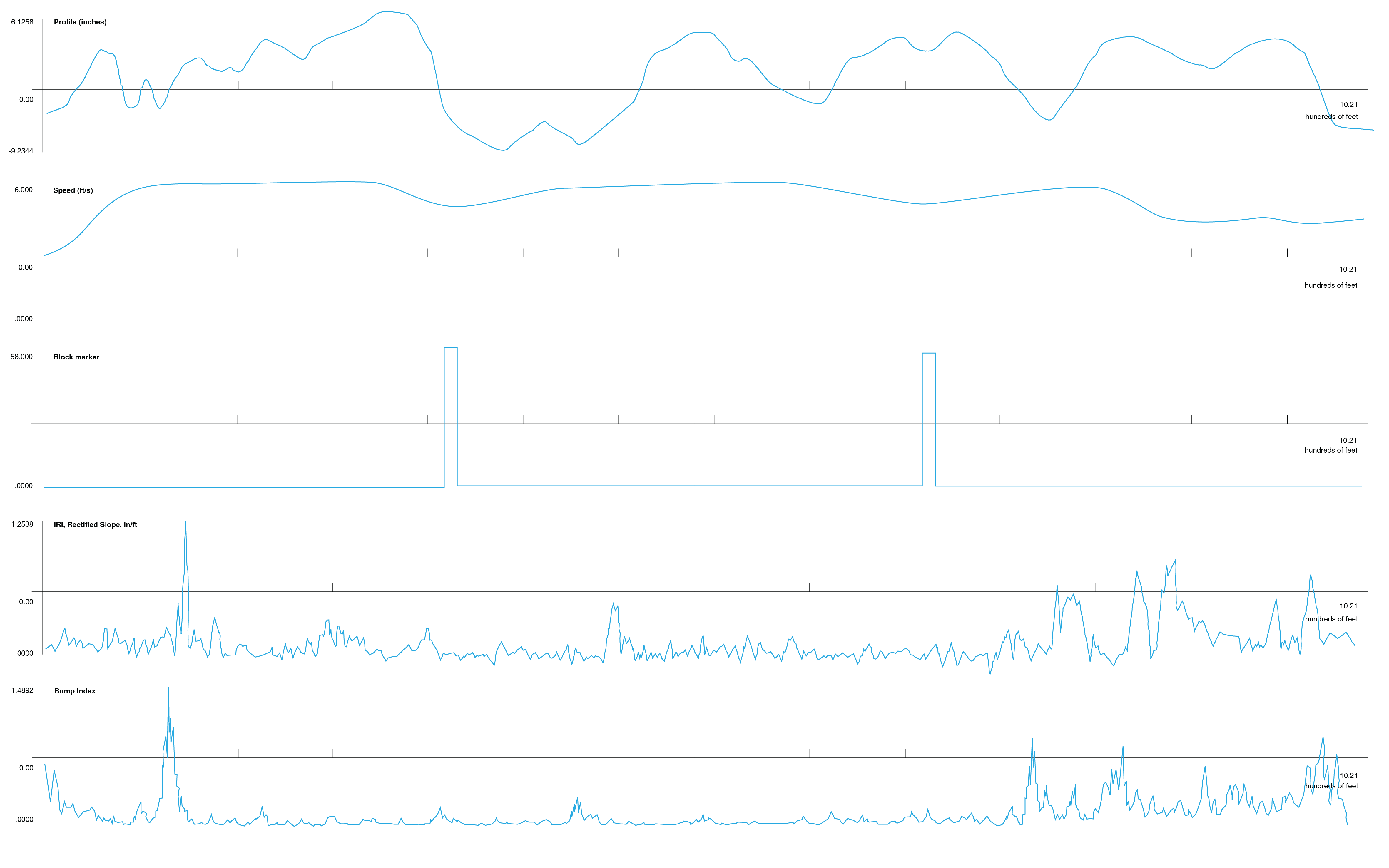
In April 2001, the Fund for the City of New York released a report that quantified the smoothness of the streets of New York.[1] The Fund hired a firm that specializes in measuring the profiles of highways and airport runways to gather data on approximately 670 miles of the city’s streets chosen at random. The New York street profiles were measured by a car which had a laser scanning device known as a profilometer attached to its side. The profilometer scans the ground and gets a reading every 0.011 inches when the car is driven at 20 mph.
The raw data, accurate to a thousandth of an inch, was then converted into two standard indices: the International Roughness Index (IRI) developed by the World Bank in the 1970s to measure road roughness, and the Bump Index developed by Boeing to evaluate runways for takeoff and landing. The World Bank provides a computer program that will process the raw data and generate the Roughness Index. The IRI indicates the total accumulated deflection of the suspension of a theoretical car per distance traveled.[2] Boeing’s Bump Index measures the ratio of the bump height to the bump length. A Bump Index of above 1.0 on a runway is considered dangerous for planes taking off or landing.
The Technical Appendix of the Fund’s report tantalizingly mentions the manual rod-and-level method as an alternative method for generating the raw data for those who cannot afford the profilometer. One sunny day in October, when no subscriptions had come in and all our article ideas looked doomed, we decided to try the manual technique to measure the three blocks immediately adjacent to our office. We then processed the data using the IRI and Bump Index. The results are on the preceding pages. We do not recommend that you try this. It is laborious and teaches you nothing.
- See www.fcny.org/cmgp/streetsmoothness [link defunct—Eds.] for an online copy of the report. The Appendix has useful technical information.
- See World Bank Technical Paper No. 46, “Guidelines for Conducting and Calibrating Road Roughness Measurements,” 1986.
Spotted an error? Email us at corrections at cabinetmagazine dot org.
If you’ve enjoyed the free articles that we offer on our site, please consider subscribing to our nonprofit magazine. You get twelve online issues and unlimited access to all our archives.