


Ingestion / Rising from the Bread
The great British loaf, ca. 1903
George Pendle
“Ingestion” is a column that explores food within a framework informed by aesthetics, history, and philosophy.
In an early draft of Marcel Proust’s monumental À la recherche du temps perdu, the narrator is sent reeling back through his memories not by the delicate taste of a madeleine cake, but by the hearty crunch of hot buttered toast. Why did Proust choose to change his edible prompt to memory? The reason is not recorded, but perhaps it was because bread was just too obvious. “Bit on the nose, isn’t it, Marcel?” one can imagine his early readers remarking, sending a panicked Proust rushing to his local boulangerie to sniff out other baked goods. Éclair? Non! Macaron? Non! Madeleine? Un moment…
Everyone feels something when they taste, or smell, bread. Usually these things are intensely positive. The ability of a yeasty whiff to conjure up feelings of home, comfort, and satiety marks bread as a powerful emotive stimulant. Psychologists have even suggested that the smell of bread makes us more prone to acts of altruism.[1] Such is bread’s ability to make us feel good that it’s now used against us as a Potemkin scent. Supermarkets pump the smell of bread into their overlit aisles to convince us to spend more time in them. Realtors put a loaf in the oven of houses they are trying to sell to impart an aura of coziness to their empty square feet. There is little we can do to stop bread marching down our olfactory bulb to the bottom of our brain and tugging on our better natures.
As much as bread is curled around our memories and emotions, it also pervades the world around us. It’s in our language as the staff of life. It’s money or dough. It’s in metaphors (“breadwinner”), idioms (“best thing since sliced bread”), and everyday words like “companion” (com meaning “with,” panis meaning “bread”). In Arabic, the word aish means both bread and life. And unsurprisingly, bread is perched at the center of our politics. Marie-Antoinette didn’t actually say, “Let them eat cake”—what she actually said was “Qu’ils mangent de la brioche,” let them eat brioche—but regardless, she was making light of her poor subjects’ bread situation, something that has frequently led to conflagrations throughout history. Bread and riot go together like, well, bread and butter, and from ancient Rome to present-day Sudan, the rising price of bread has been a perpetual cause of revolution. Sometimes it seems as if all human existence can be found baked in alongside the flour and salt.
Not that Owen Simmons’s The Book of Bread (1903) cares for such cognitive, linguistic, or political investigations.[2] It does not look for meaning in bread, nor does it wallow in the mawkish meanderings of modern cookbooks. Herein are no pandemic-era paeans to the meditative slowness of baking, nor disquisitions on the wellness benefits of carrying around one’s own sourdough starter. The Book of Bread’s interest is solely in the baking and judging of prize-winning loaves, specifically British loaves, as white and soft as the rulers of the Empire itself.
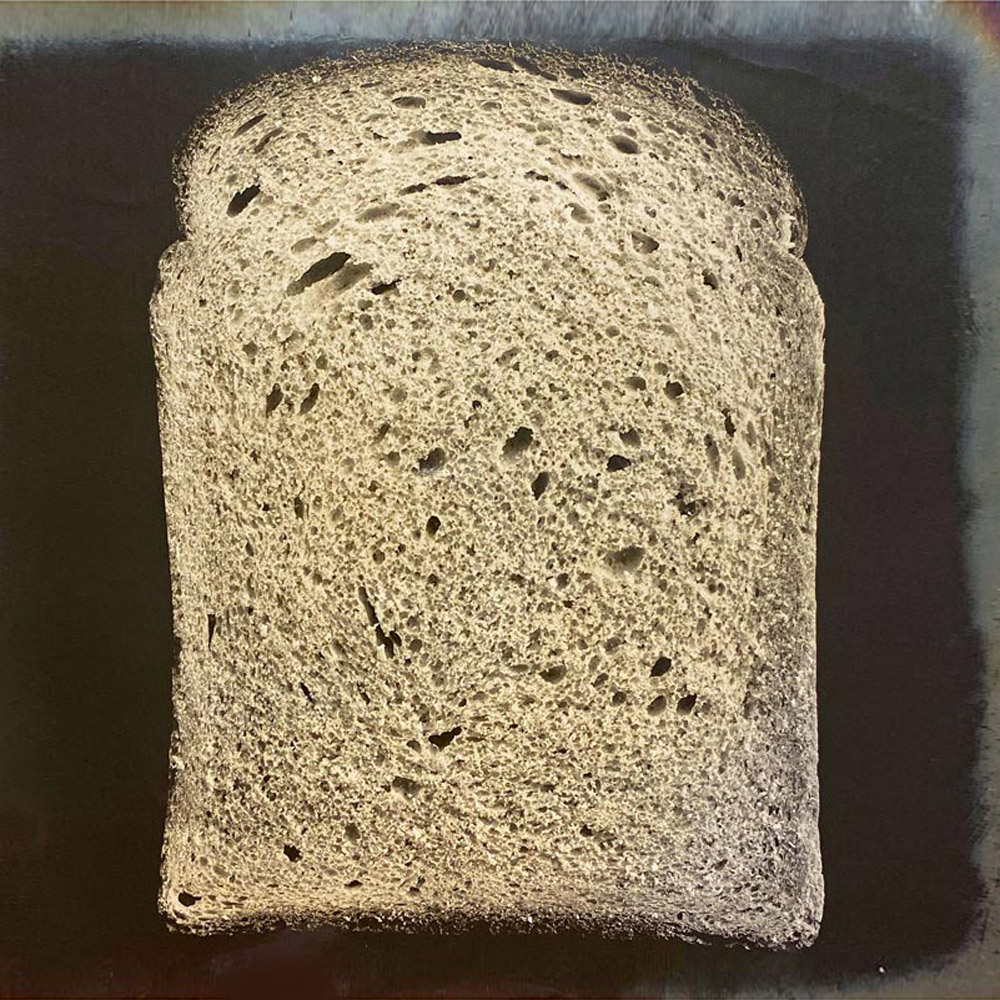
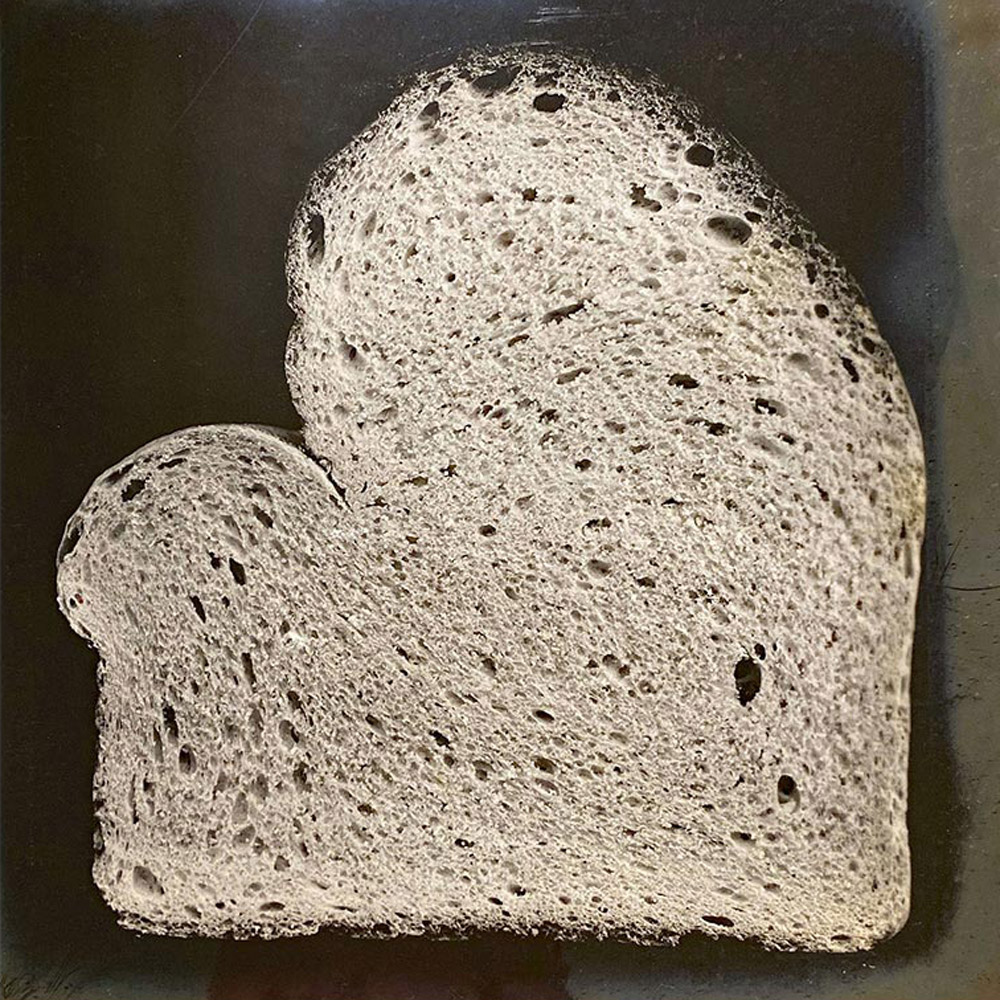
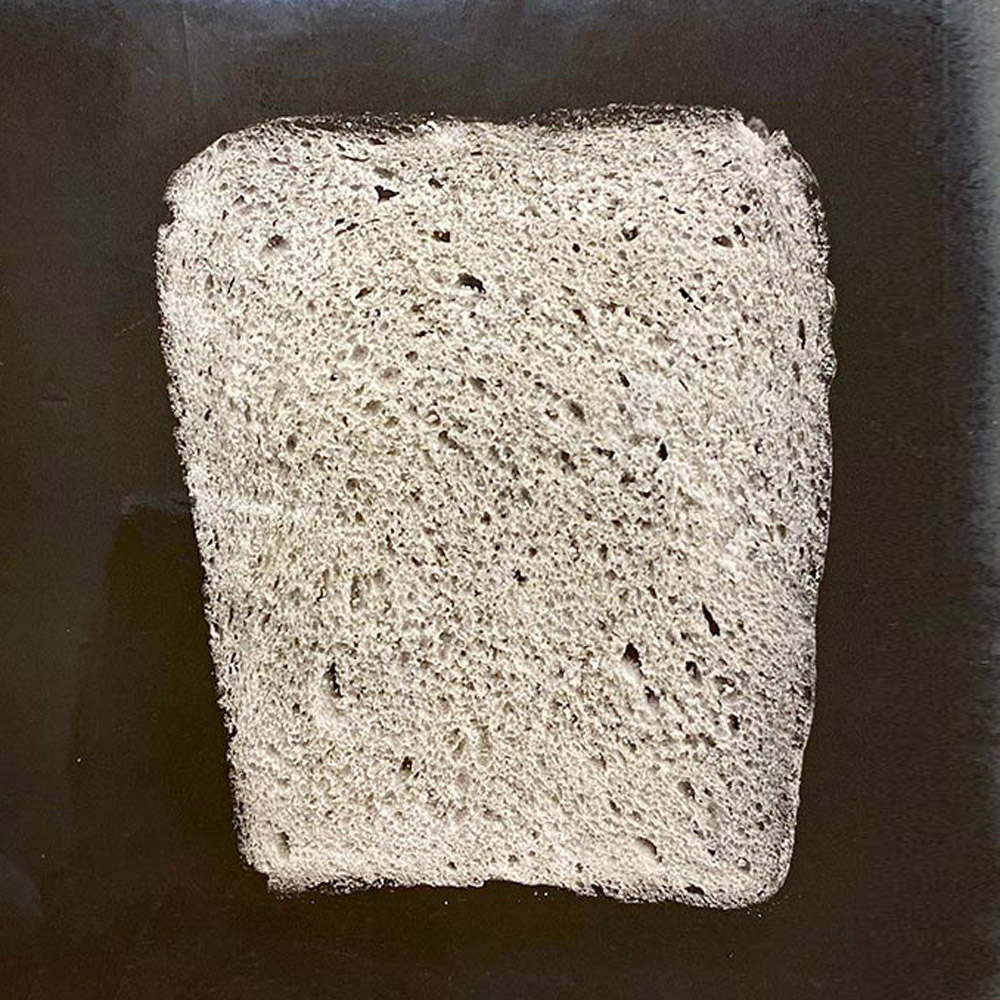
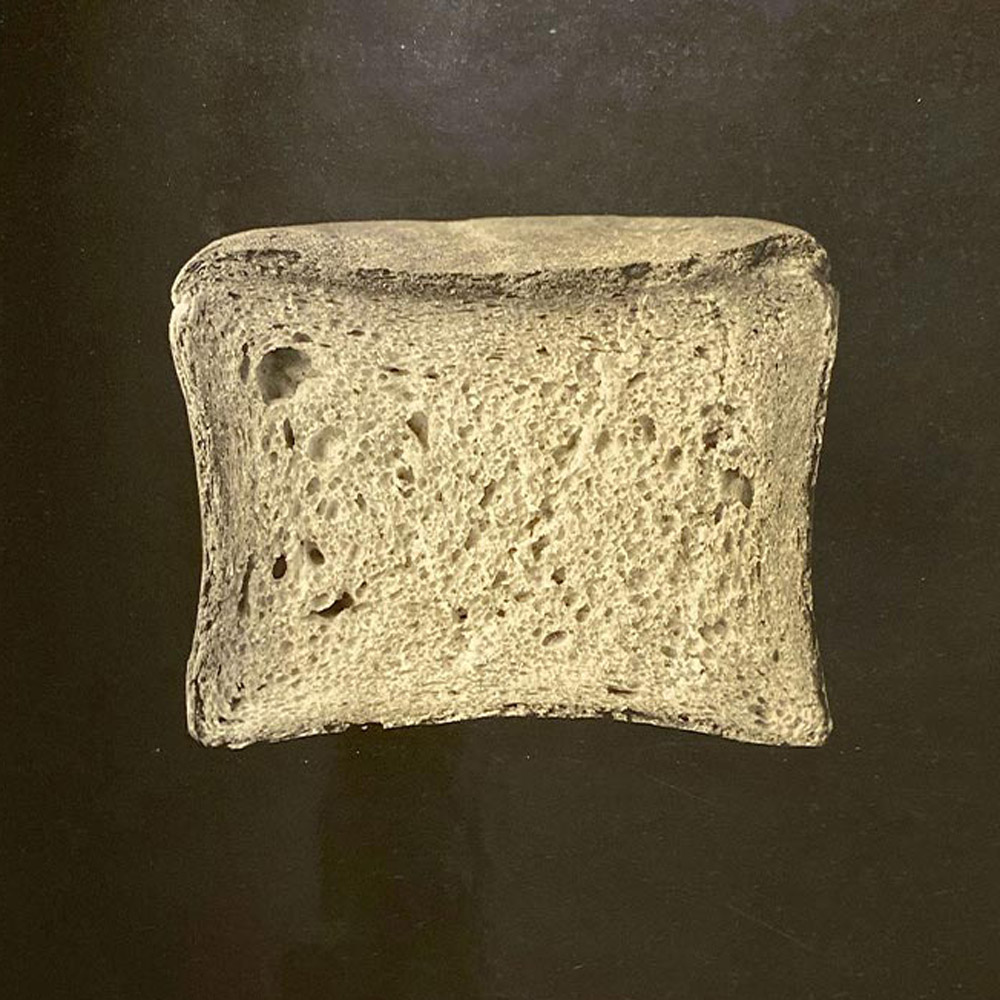
There are painstaking details on salt and malt and flour and sugar, the proportioning of gluten and yeast, and innumerable discussions on volume, texture, and crumbliness. “A loaf to be of good texture,” writes Simmons, “must not only be of fine and regular mesh, but also of soft, pliable, and springy crumb, that is, not coarse to look at, nor hard or unyielding to the thumb when pressed, nor yielding too much, or more in some places than others, without quickly recovering the indentation.” No remembrances of things past lurk here.
Occasionally, a sliver of something beyond the pan can be sighted. A long disquisition on sourness in bread reveals glimpses of an authoritarian streak in Simmons: “Twenty ruffians in Trafalgar Square without a policeman will be more dangerous than twenty thousand in Hyde Park under proper control. We cannot purge society of its blacklegs, so we make laws and appoint custodians of those laws. Likewise we cannot annihilate lactic germs from our bakeries, but we can decide upon rules, and place a strong cordon of yeast cells over the unruly.” Similarly, at the start of an interminable chapter on gas bladders, dough kneaders, and flour sifters, the author conveys the baking industry’s luddite ways by quoting Shakespeare’s Measure for Measure: “Our doubts are traitors, / And make us lose the good we oft might win / By fearing to attempt.”
But in general, Simmons writes with all the prosaic passion of the Victorian didact. His fleeting digressions into foreign breads are short and severe. Sardinian earth bread, in which earth and water are mixed with acorn flour, is assigned much of the blame for the delinquency of that island’s natives. Armenian “hunger bread,” made of clover seed, flax, and grass is described as “not a delicacy, but a stern reality.” At one point, Simmons describes sugar with almost superhuman mundanity as “this well-known sweet crystalline substance.”
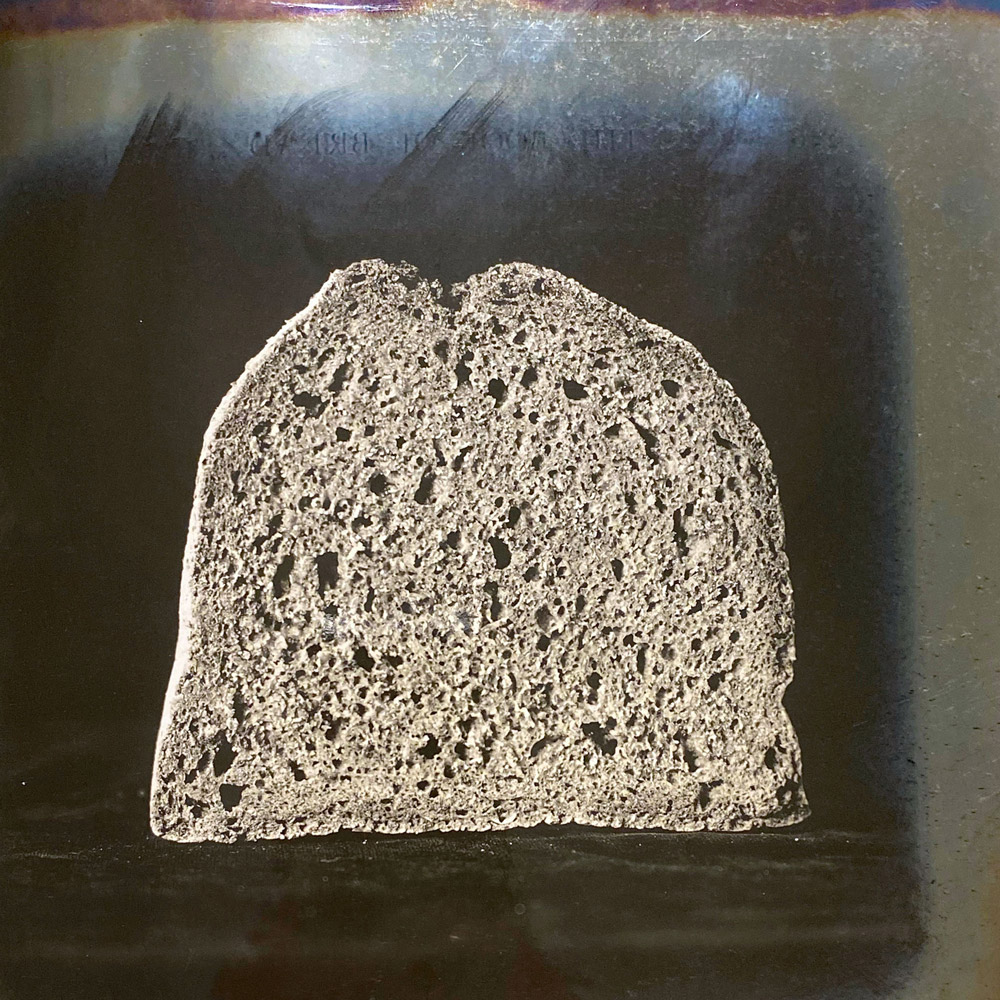
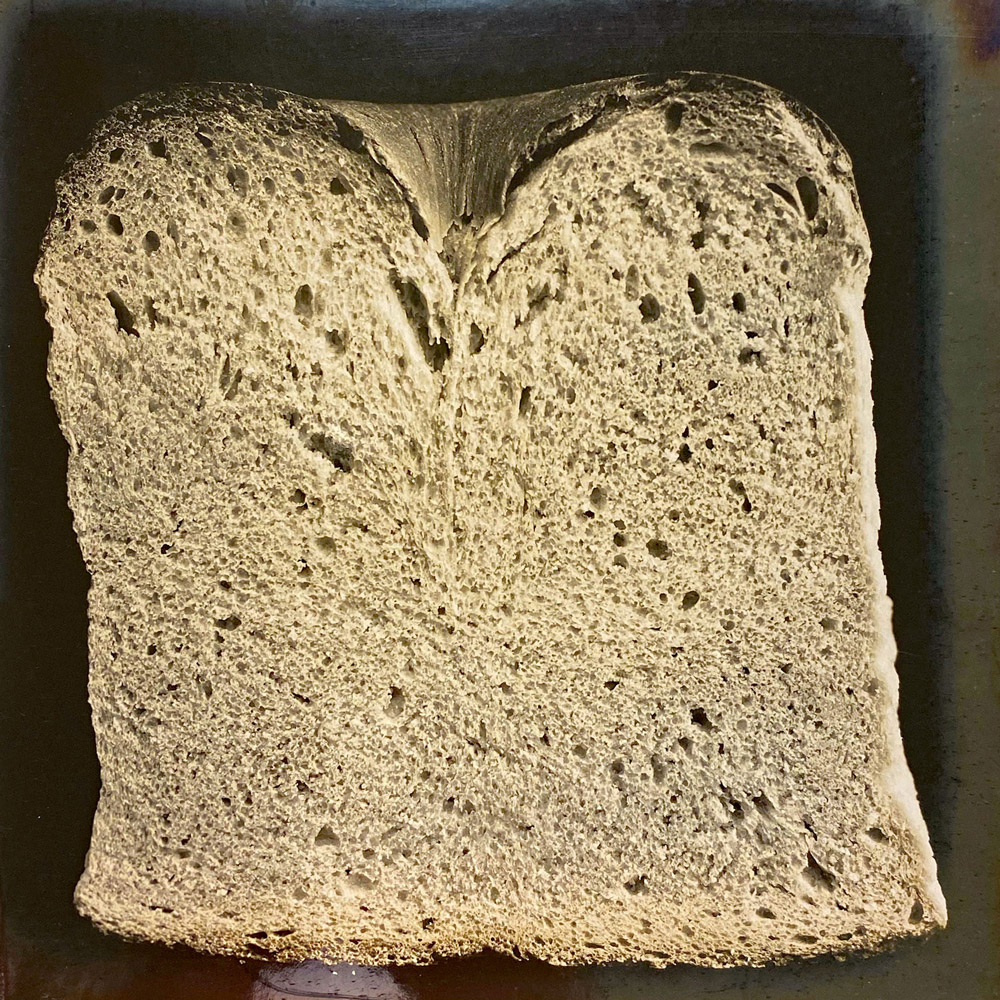
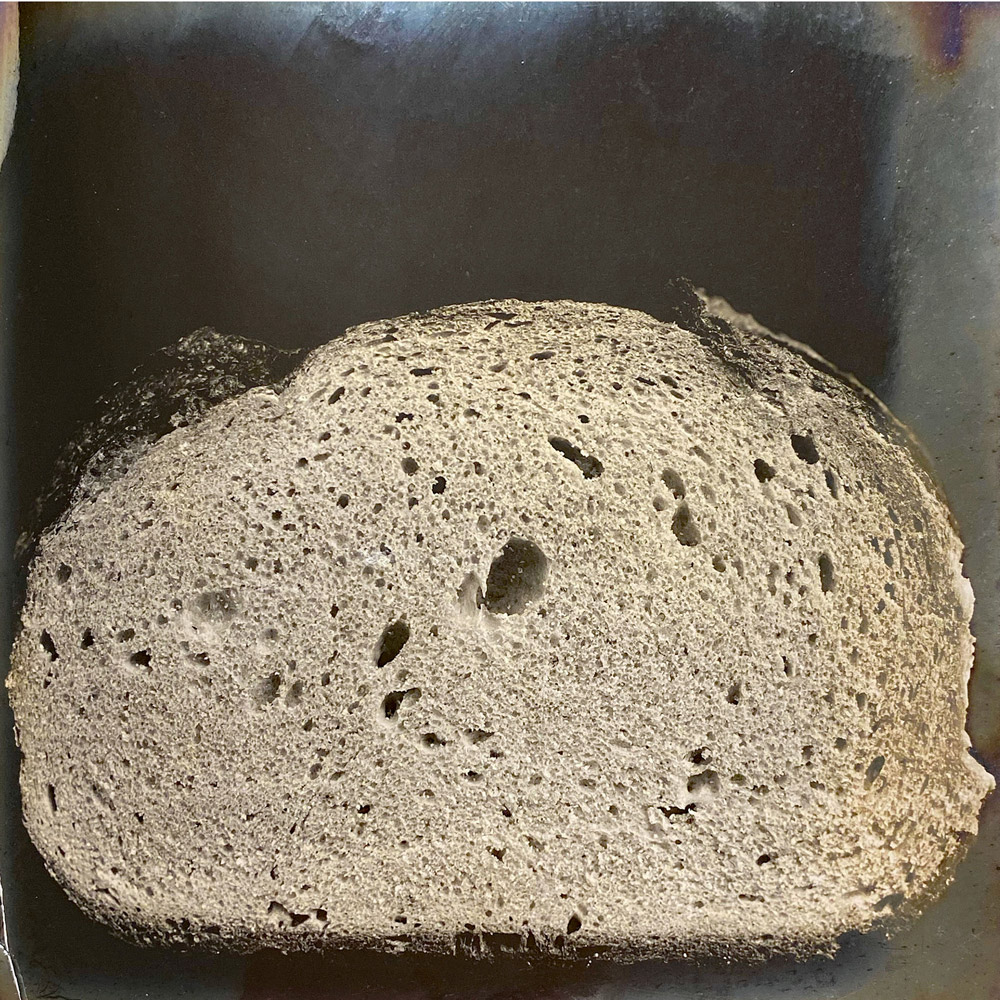
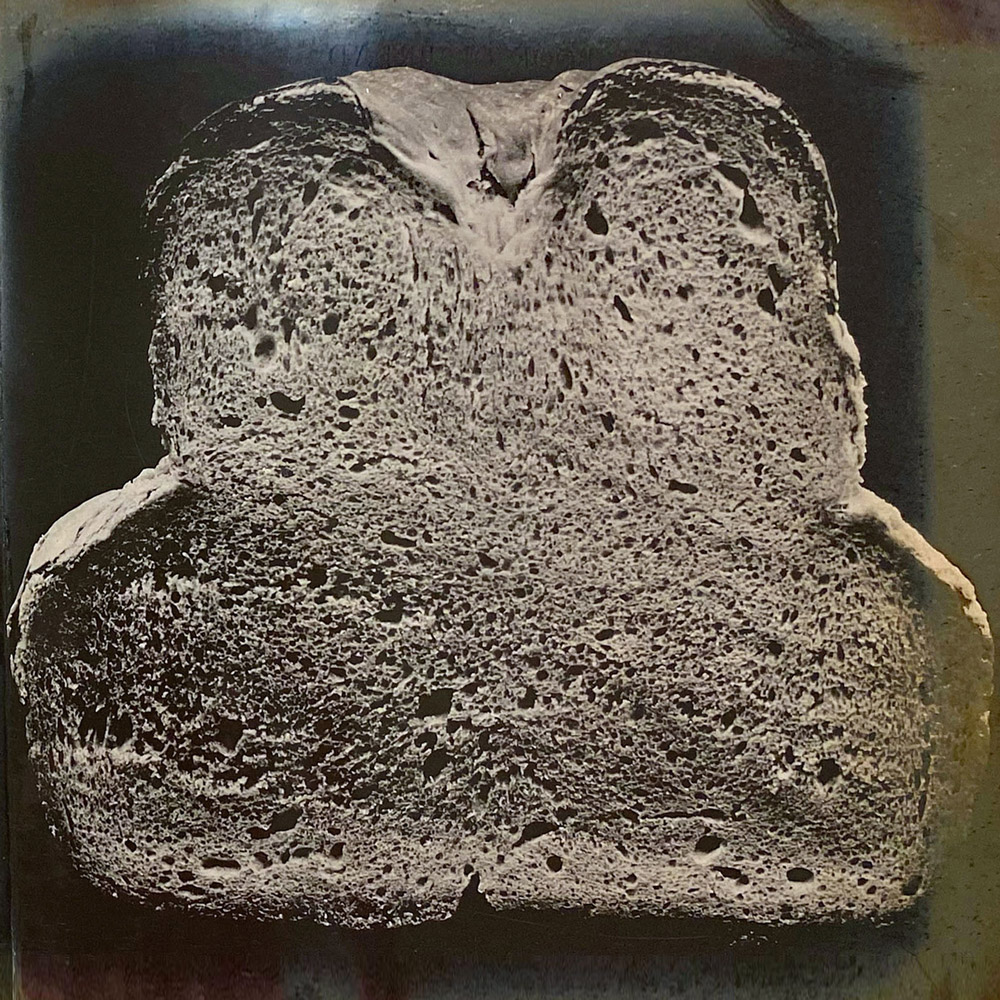
Yet sometimes we can’t help ourselves but sing. Try as we might to strap ourselves down or button ourselves up, eruptions occur. Simmons can straitjacket his prose all he wants, but when it comes to the book’s illustrations, he profoundly fails in keeping bread in the bakery. Bread is too powerful a totem, too rich in meaning, to be held down for too long.
To begin with, there are a series of black-and-white photographs—gleaming silver bromide prints in the deluxe edition—that are spare, empty, and seemingly devoid of signifiers. Labelled simply “Section of Good Commercial Tin Loaf” or “Section of Crumby Loaf,” one illustration after another depicts cliff-like, yeast-pitted slices staring blankly back at us. To the untrained baker’s eye, they are nearly indistinguishable from one another. But in their similarity, they speak eloquently of the fundamentality of bread. The photographer Martin Parr, known for his technicolor explosions of the everyday, has claimed that these images of Simmons are “catalogued as precisely, rigorously and objectively as any work by a 1980s Conceptual artist.” But really the black-and-white illustrations found in The Book of Bread more closely resemble the 1960s typological work of the artist Ed Ruscha, who in photobooks such as Twentysix Gasoline Stations (1963) and Some Los Angeles Apartments (1965), made serial inventories of everyday, banal places in a matter-of-fact, deadpan manner. In The Book of Bread, there is a similar rigorous purity to the repetition of images. Framed within the page, they appear like empty frames themselves, waiting for us to spread our own understanding onto them. This is bread as basic sustenance, the bread that keeps the wolf from the door, bread as bread. Displayed with rigorous purity, “dead-head, straight-on without much emotion,” as Ruscha would say of his own photographs, this is le pain quotidien.
Yet as we and Marcel Proust know, bread has a dual nature. As well as sustenance, it also offers transcendence. So, whether consciously or not, Simmons provided a second set of illustrations in The Book of Bread, dazzling full-color chromolithographs depicting golden whole loaves against a wash of vivid blue. Here the loaves astonish, their crumb shines angelically, their crust gleams like a burnished shield. In these pictures, bread is not a daily substance but an extraordinary, almost radioactive, one. These are not illustrations of bread’s Ruscha-like black-and-white banality; these are full color loaves that reach toward the divine. Indeed, you can find a concordance to the rich blue backdrops found in The Book of Bread in the Marian blue often found in depictions of the Virgin Mary’s cloak in Renaissance paintings. That blue has long symbolized purity—something that bakers of bread have historically been obsessed with. And the gleaming golden loaf, emanating light? This can only be a direct reference to the Son of God himself.
To a master baker, even one as aloof as Simmons, the leap between Jesus Christ and a loaf of bread would have been a small one. After all, no religion has been quite as obsessed with bread as Christianity.[3] Bread is the first and only physical item asked for in the Lord’s Prayer, while Jesus is a veritable carbaholic in the New Testament, feeding the five thousand with five loaves, referring to himself as “the bread of life,” and even being born in the town of Bethlehem, which can be translated as, “the house of bread.”
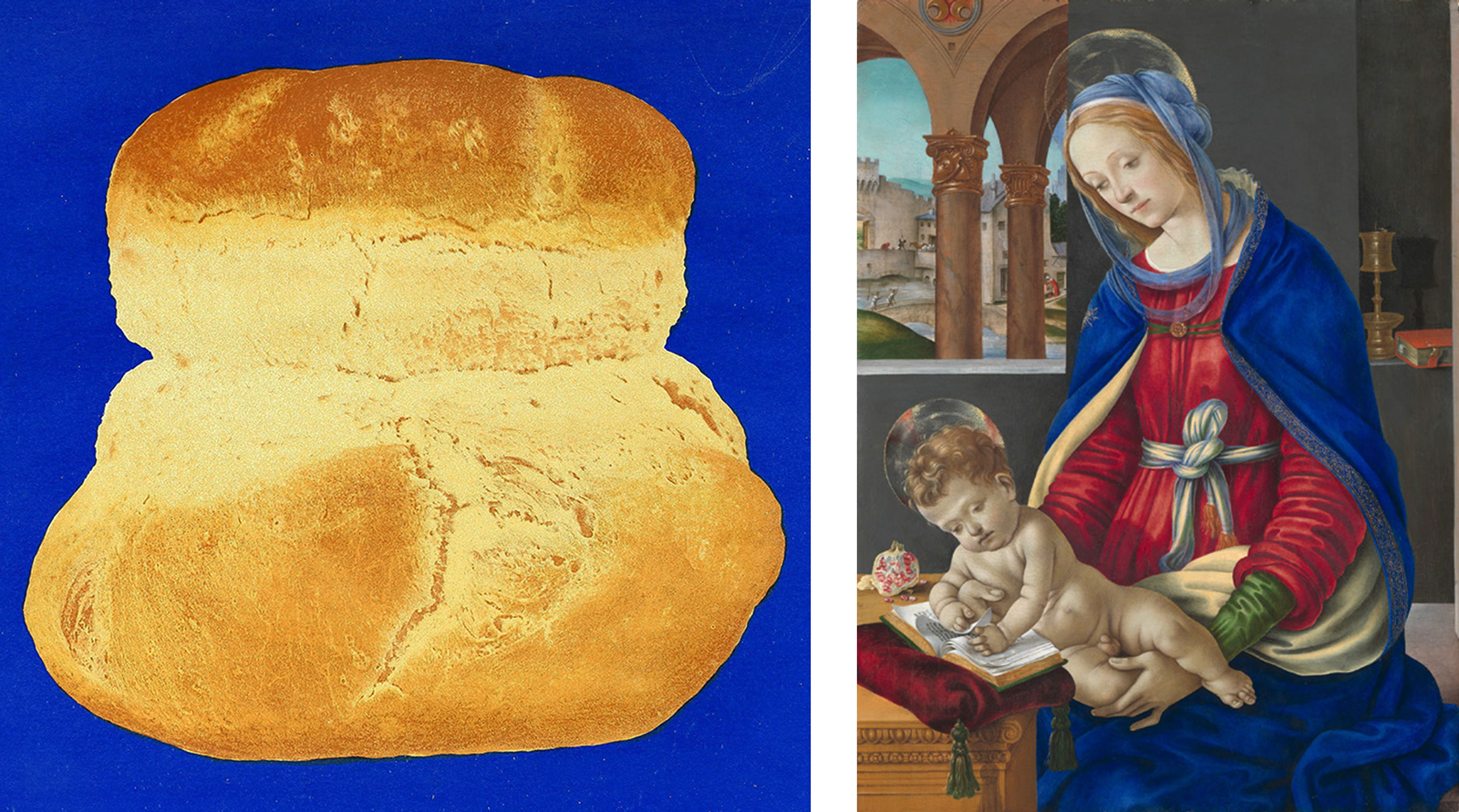
However, it’s in the Christian doctrine of transubstantiation—in which the sacramental bread given to believers magically converts itself into Christ’s body—that Christianity and the baking of bread become one.[4] In one respect, this doctrine infuses the humble, unleavened bread, available to even the poorest believer, with a divine power. But in another respect, far less remarked upon, it also infuses Christ with the wondrous qualities of bread.
For all his Victorian dogma, Simmons can’t help but reveal the radical, even heretical, proposition that as much as bread can be god, so god can be bread. We look at these Renaissance pictures of the Madonna and Child and they exude a familiar feeling of home, of comfort, and satiety. But, dare I say it, they also speak of deliciousness. Look again at those paintings of the Madonna and Child side by side with Simmons’s illustrations. The baby Christ, with his thick gleaming sides of chub, appears soft, pliable, and springy. He is not coarse to look at, and, one can imagine, neither hard nor unyielding to the thumb. In short, Christ resembles nothing less than one of Simmons’s English Champion Cottage Loaves. Don’t you just want to eat him up?[5]
- Nicolas Guéguen, “The Sweet Smell of … Implicit Helping: Effects of Pleasant Ambient Fragrance on Spontaneous Help in Shopping Malls,” The Journal of Social Psychology, vol. 152, no. 4 (July–August 2012). Available at pubmed.ncbi.nlm.nih.gov/22822681.
- The Book of Bread was published in at least three versions; the deluxe, the standard, and the shorter standard. The deluxe and standard versions, perhaps printed at the same time in late 1903, are identical in their content but the deluxe version is printed on finer paper, has an alternative binding and different endleaves, and, most importantly, includes ten tipped-in silver bromide photographs of cross-sections of bread loaves. The standard edition has ten tipped-in images as well, but two were reproduced in a cheaper silver gelatin format and the other eight were simply prints. There is no date of publication on the title page of these two versions, but an advertisement included in the back of the book bears the date “October 1903.” Whether the book was printed in late 1903 or in 1904 is a matter of speculation. At some later point, a shorter version of the standard edition, different only in its back matter, was published; this version, which is the one most often offered for sale by antiquarians today, is usually dated by them to 1903, but was likely printed in 1904 or later.
- The custom of eating bread sacramentally as the body of a god was practiced by the Aztecs long before the conquest of Mexico.
- The rival, if less popular, doctrines of consubstantiation‚ in which Christ is said to be present alongside the sacramental bread, like the filling in a sandwich, and impanation, in which Christ literally becomes bread as opposed to vice versa, similarly stress the links between the holy and the doughy.
- The role of so-called dimorphous expressions of emotion—the urge to squeeze, bite, and pinch babies—has yet to be fully discussed with reference to the infant figure of Christ and transubstantiation.
George Pendle is a writer living in Washington D.C. He writes for Air Mail, Esquire, Frieze, Financial Times, and other publications.
Spotted an error? Email us at corrections at cabinetmagazine dot org.
If you’ve enjoyed the free articles that we offer on our site, please consider subscribing to our nonprofit magazine, which includes unlimited access to all our archives.