


Wallpaper
A memoir
Sally O’Reilly
In 1941, following his release from internment in the United Kingdom as an enemy alien, Austrian engineer Paul Eisler convinced a British lithography company with a focus on sheet music to invest in his idea of printed circuitry. The company sensed the promise of sleek conductive pathways printed onto insulating substrates, which would dramatically debulk the manually soldered wires of electronic equipment, and immediately drew up a contract. As a gesture of good faith, Eisler signed without reading, and inadvertently handed over all rights to his invention for one pound sterling.
Despite Eisler’s best efforts to place printed circuit boards within a non-military sector, they were soon co-opted by the United States for use in proximity fuses—the detonator component of electronic explosive devices that brought down aircraft and V1 rockets more efficiently than mechanical ordinance. While his estranged invention was changing the course of World War II, Eisler took out patents for peripherals whose narrow, limited applications of printed circuitry failed to capture the civilian market’s imagination. Even his heated wallpaper, seemingly a goer at first, would soon be toast. The discovery of natural gas in the North Sea and the development of domestic boilers were about to ignite a central-heating takeover of Britain’s homes.
Wallpaper, electrical and otherwise, hums quietly in the background: a visual pedal note. If it is loud at first, trumpeting floral or geometric airs, it retreats, on repeated exposure, into the thrum of sheer presence. Once settled back in its rightful place, it plays the supporting role of everyday trivial ubiquity, though the backdrop might step to the fore once again in exceptional circumstances. In times of scarcity, newspapers have been printed on the back of wallpaper, for instance. The 2 July 1863 edition of The Daily Citizen in Vicksburg, Mississippi, published its reports on the US Civil War on the back of decorative whimsies and vague botanicals. In 1982, the year of Sotheby’s publication of Jean Hamilton and Charles Oman’s Wallpapers: An International History and Illustrated Survey from the Victoria and Albert Museum, and of a French translation of Charlotte Perkins Gilman’s short story and feminist classic “The Yellow Wallpaper,” Adele Rose wrote one of the most controversial storylines of the British soap opera Coronation Street. Deirdre Barlow, already bored by her recent marriage to Ken Barlow, began an affair with Mike Baldwin. Ken ignored her, she complained. Mike made her feel alive. Eventually confessing all to Ken, she said she felt like “the wallpaper, or a piece of furniture that’s been around forever.” In an unscripted move, Ken, enraged, grabbed Deirdre by the throat and began to throttle her. Actor Anne Kirkbride did not need to act Deirdre’s shock.
As an art student in 1990—the year that patents were granted for a wallpaper preparation apparatus, a wall-panel unit, blind slats into which strips of wallpaper can be inserted, a dispensing and wetting tray, holographic wallpaper, a knife guide, a wallcovering display rack, a paper scarifying tool, a portable apparatus for wetting pre-pasted wallcovering, and a non-electrographic printer with lamination means—I had intuited something of the tensions inherent in wallpaper. I’d clocked how it could be omnipresent and unheeded, that it was various and particular yet generic, banal and big business. Such minor paradoxes have inordinate gravitational pull on those only just realizing that contradiction is the universal substance. How amusing, I thought, to make people lavish attention on a literal peripheral.
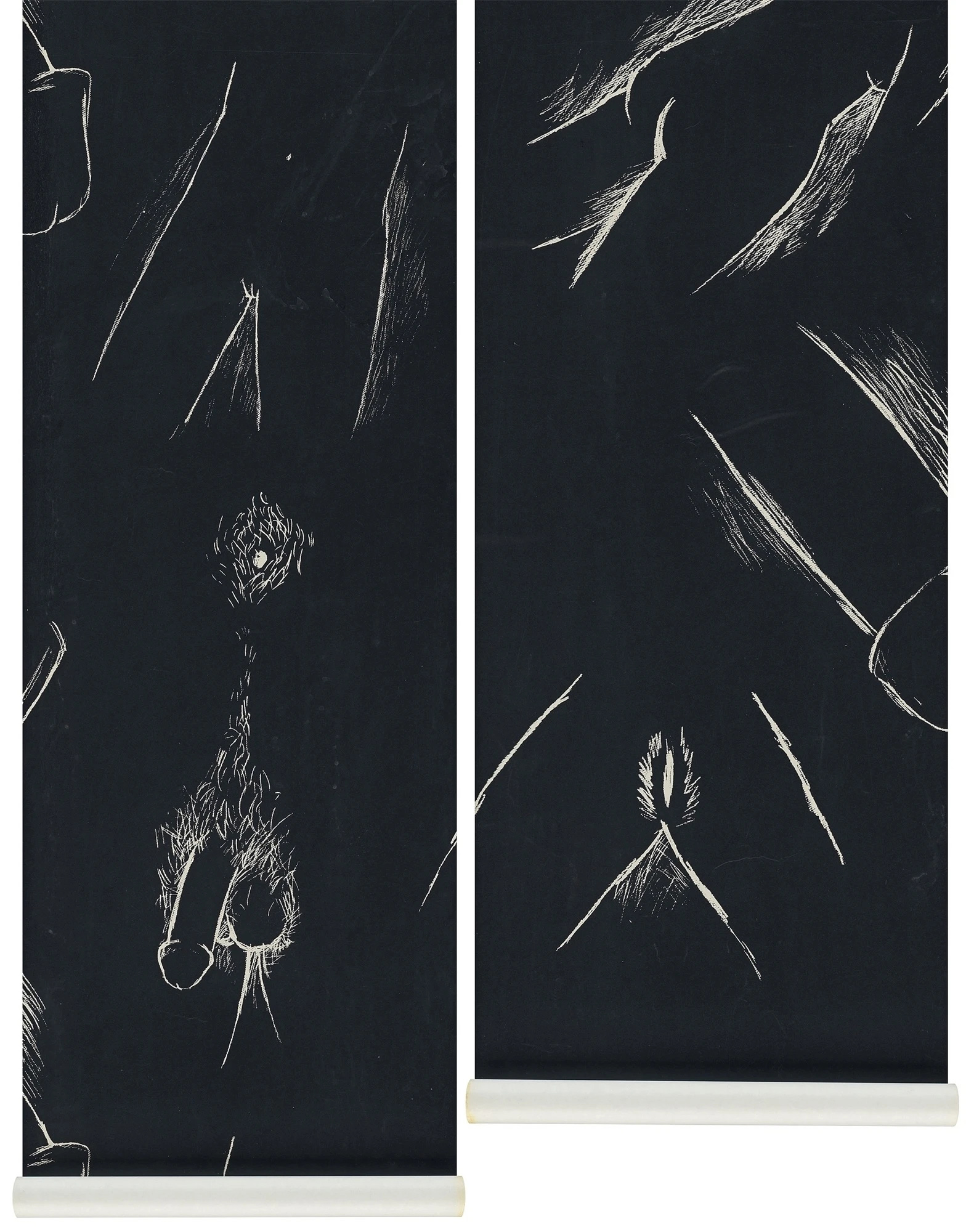
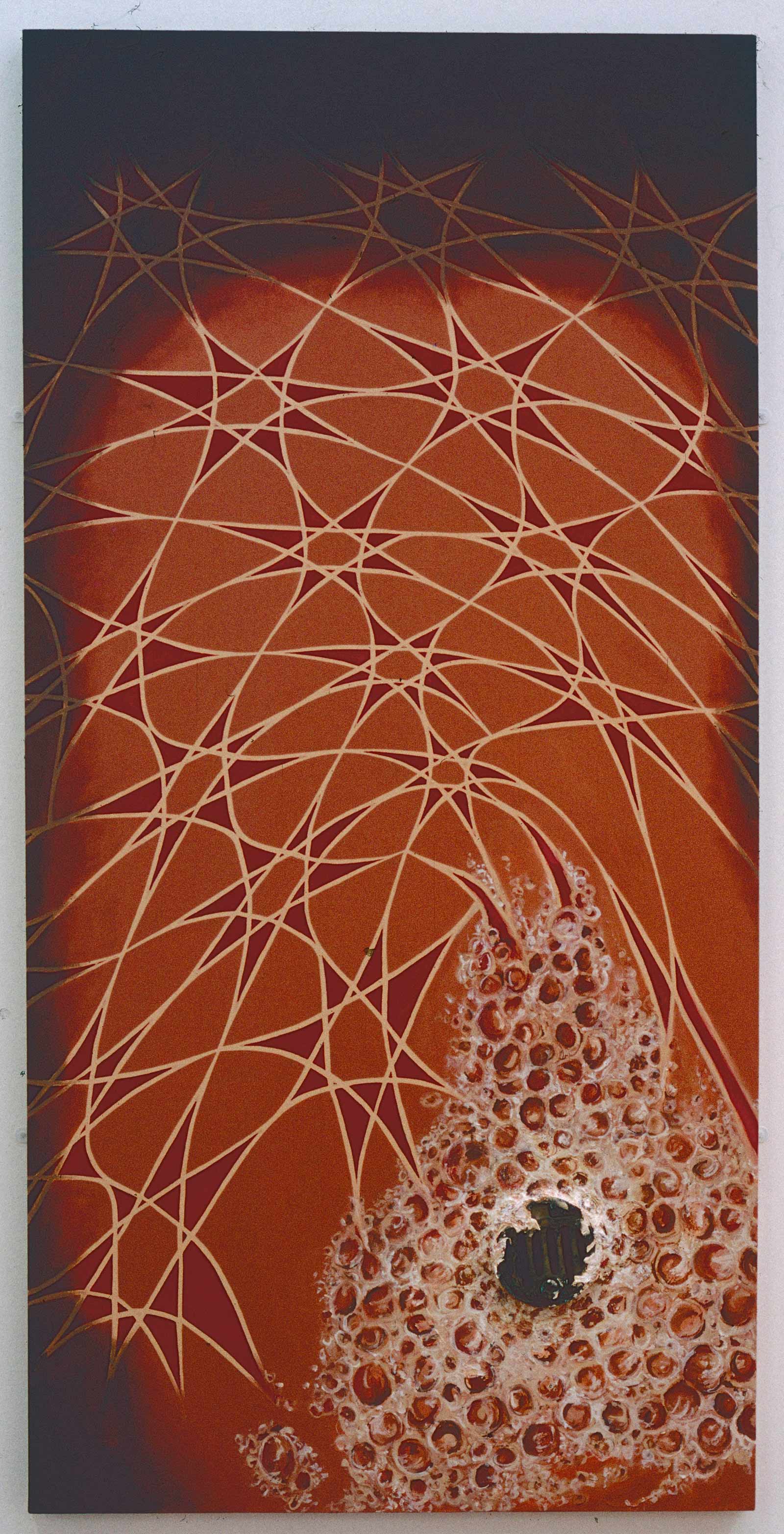
There was meager precedent for wallpaper in art that I was aware of. I’d seen, and not understood, Robert Gober’s Hanging Man/Sleeping Man wallpaper, and not seen his Male and Female Genital Wallpaper, which I might have grasped. (Both were produced in 1989, as was a BBC television adaptation of “The Yellow Wallpaper.”) I’d heard people commend the “all-overness” of Jackson Pollock paintings, declaring them a radical rejection of figure-ground conventions, though I’d not read George Steiner deriding them as “vivid wallpaper” in 1961. With some vague and garbled idea in mind about alternate realities, I made paintings of wallpaper in thrall to utterly unfantastical forces. A pattern, purloined from a design magazine and imbued with physically improbable but ultimately dull properties, stretched across deep, boxy canvases or dissolved to a lather that drained out through a metal grille.
Looking back to one’s juvenilia is like watching a dog trying to open a door. My nostrils had caught a vapor—a whiff of quantum weirdness—but I was trapped in the cold, tight scullery of conventional schooling, customarily tiled with Euclidian logic. My efforts amounted to little more than minor, a-critical distortions. I might have noticed that it was often hard to remember that wallpaper is not the wall itself (for it sticketh closer than a brother), but the politics of the unseen subject passed me by entirely. I jabbed my blunt instrument right through the socioeconomic conditions in which wallpaper attains its meaning, and on down to the bare rock of physics, which stared back, expressionless, with not much to say to an art student.
Today, I would expend all my energies scratching about in the socioeconomic topsoil. I would think about how, originally, wallpaper was laboriously handpainted or block printed—the province of the moderately wealthy to the filthy rich, until technological developments made it viable for the middle classes. I’d consider the Napoleonic Wars’ blockade of international trade, and the flood, following the Second Treaty of Paris in 1815, of cheaper, more colorful wallpaper cascading into Europe from the new British steam-powered printing presses. And how the industrial revolution brought wallpaper to the masses, so that even the working classes could brighten up their dark, cramped quarters. And I’d look into the fluctuations of wallpaper’s prevalence and reach since: pinched by serial global and regional wars, the oil crisis of the 1970s, and the undue popularity of rag-rolling (in the UK, at least); boosted by developments in plastics and the DIY revolution (or is it a relapse?) of the 1960s. I would note how its styles have been steered by new technological processes and the “discovery” of “other” cultures, by the prevailing winds of fashion and the unaccountable outbreak of fads. The early pictorial panels of the sixteenth century, the leather walls of the Sisters of Loreto convent in a southside suburb of Dublin, the hoary floral flock of Victorian pubs, and 1970s wipe-clean plasticated jazz would all have much to say about their respective epochs. Perhaps I might make an animated visual chronicle of wallpaper, filling a wall-sized screen with a brisk montage of patterns—arranged chronologically in a materially, socially, and aesthetically impelled rolling mutation—so as to put straight to bed, with no supper, the myth of linear progress.
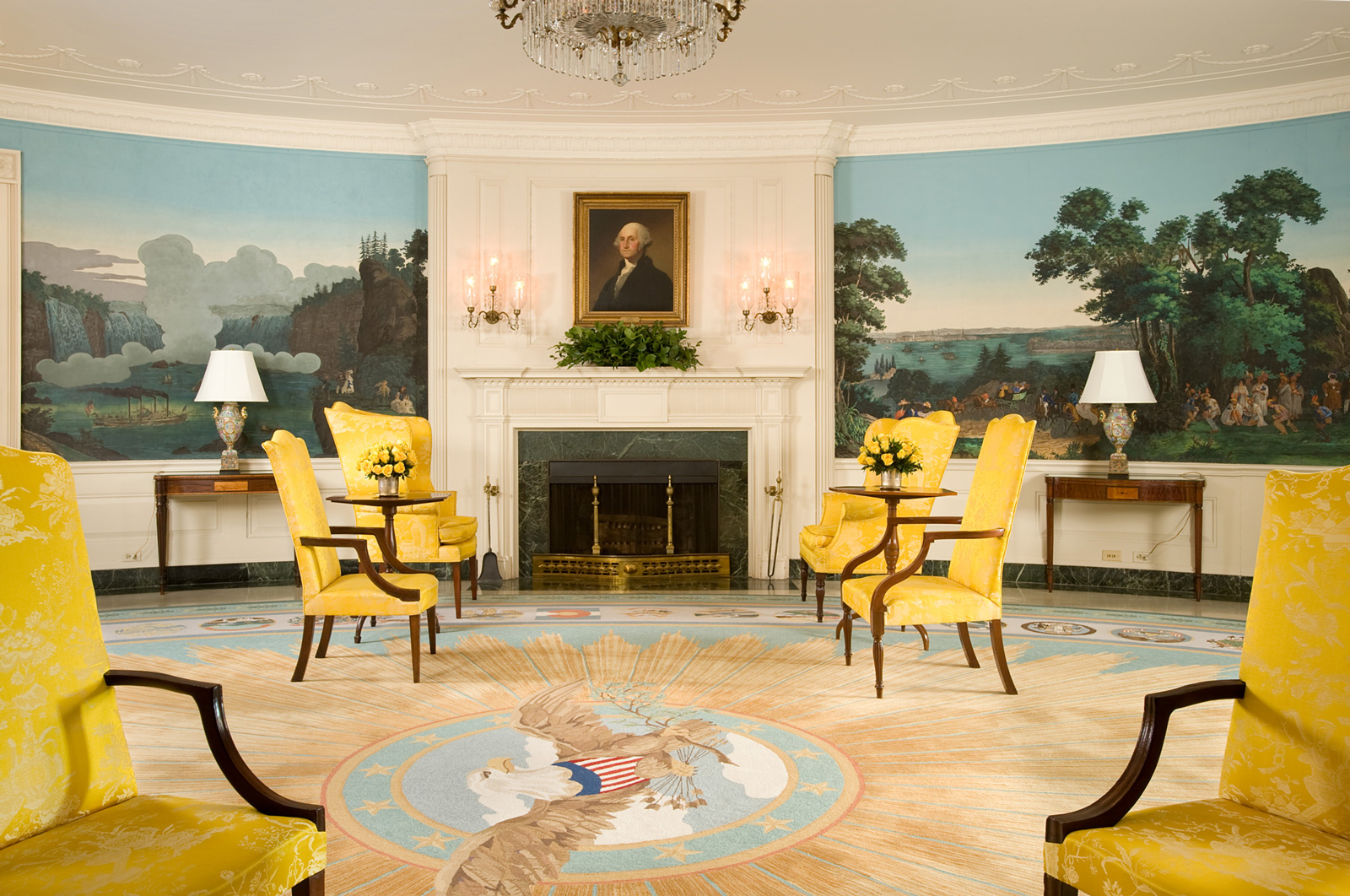
Laura Bush loved the Zuber wallpaper chosen by Jackie Kennedy for the White House’s Diplomatic Reception Room. Scenes based on 1820s engravings of New York, West Point, the Natural Bridge of Virginia, Niagara Falls, and Boston Harbor still cuff that ovular chamber in which many futures have been hatched. All wallpaper flags a decision that is being lived with. For now. Perhaps soon it will be countermanded and covered up with a fresh decision—the trace of a lapsed state of affairs waiting to be rediscovered among archaeologies of paint and paper, or found adrift as a torn, mildewed remnant behind a radiator. A past so beautifully distressed quickens the pulse of romantics with a predilection for fragility, lost splendor, ruins.
At some point, in the 1980s perhaps, history became the heritage industry, and past mundanities turned out to be worthy of display. Consequently, wallpaper conservation now looms large. In situ in castles, country piles, and the town houses of historical figures, antique wallpaper must be preserved from UV light, mold, and insects. There are archives of samples and rescued artifacts; museums curate wallpaper exhibitions. I am tickled by the conceptual archness of a show consisting only of walls.
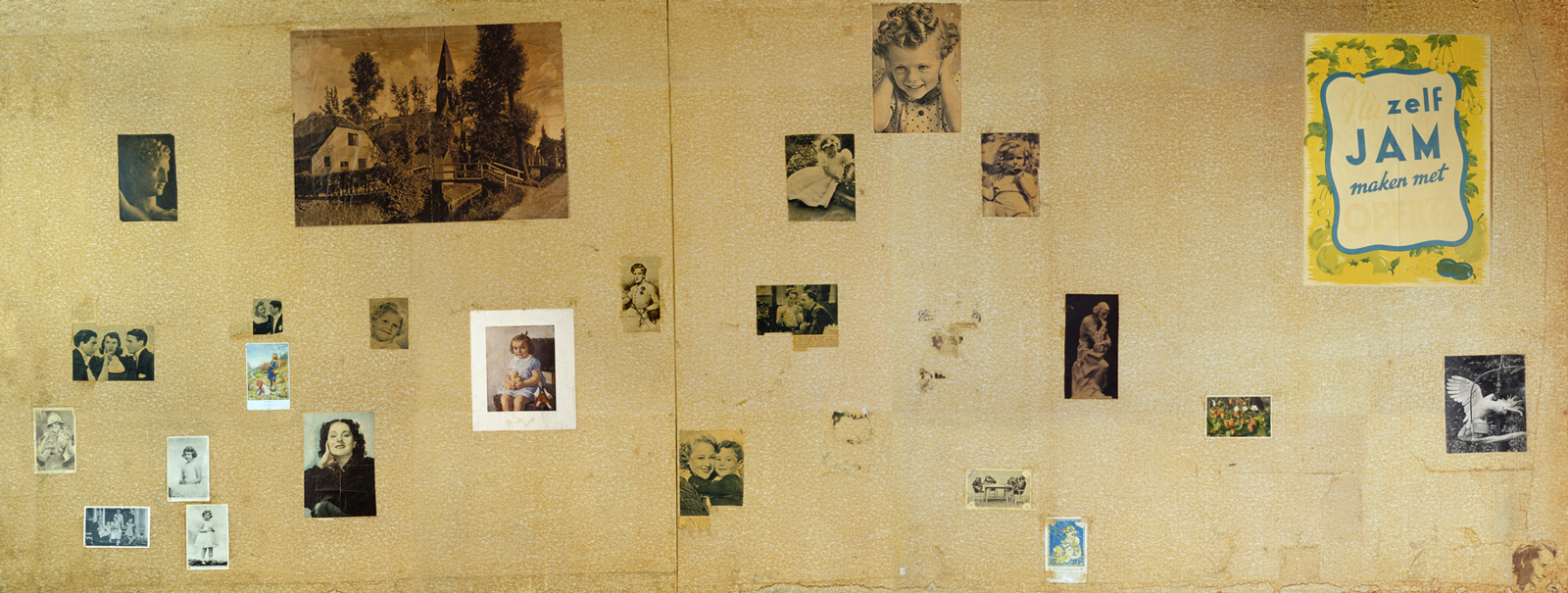
In 1960, the same year as the publication of E. A. Entwisle’s A Literary History of Wallpaper and Lucille Margaret Thomson’s A Silk Screen Project of a Wallpaper and Two Fabrics Coordinated in Subject Matter and Color, the Anne Frank House opened as a museum, housing the diary and relics of the family’s life—among them, Anne’s movie star posters, a section of wallpaper where Otto marked the height of his growing daughters, and a wall-mounted map, now behind Perspex, on which he tracked the advance of the Allied Forces. In 1990 (the year of the wallpaper preparation apparatus, the wall-panel unit, blind slats, etc.), Rachel Whiteread cast a living room in plaster, capturing in its surface patches of wallpaper and specks of paint—signs of taste (or decisions made, at least), and therefore of life. Ghost would be scaled up a few years later using similar means to cast a whole house in what had been a working-class terrace in east London. House was made in 1993, the year that a wallpaper trimmer, a decorative molding strip, and a wallpaper-paste-applying apparatus and its method of use were granted patents, the year that Lucretia Robertson and Donna Lang’s Decorating with Paper: Creative Looks with Wallpapers, Art Prints, Gift Wrap, and More was published, and that Kim Dyett’s electronica album Wallpaper Music was released.
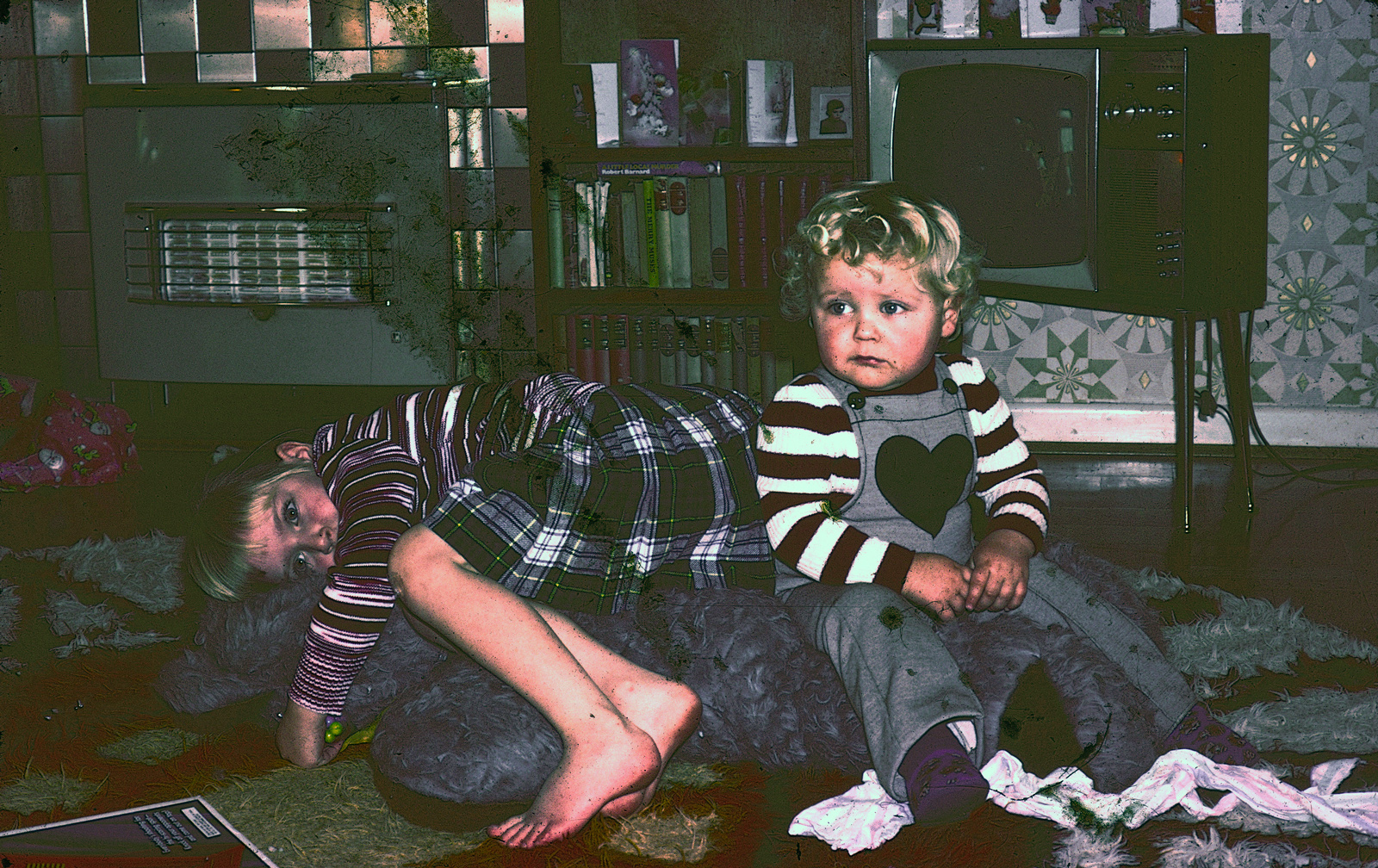
Last summer, I was scraping back the kitchen wall in our mid-century London flat, divining the arc of its aesthetic development. (Granny Smith-green doors! Electric-blue lino!) In that gormless state brought on by repetitive work, I peered down the backward telescope at my own childhood, which had begun nine years after the completion of the block I currently call “home”—the same year that Andrew Melvin’s monograph on William Morris’s wallpapers and designs was published and that David Beal photographed a bedroom with bold yellow rose-patterned wallpaper and French-style furniture in pastel-toned materials, with a highly glazed ceiling, and yellow repeated in the velvet lampshades and cushions. A thing of two halves, my childhood was at first with wallpaper, then without.
My first memory is surely fabricated. I am running past a wall of complex, subtle, and silvery 1960s geometries, crying, “Daddy, don’t go.” This image is blurred by the thickness of time, but also through toddler’s tears and the effect of running past a pattern; and it is overlaid with a scene of me stood petulantly, in the same spot, throwing boiled sweets on the wooden floor—the clatter, so naughty!—shouting, “No!” This wallpaper was likely hung by my parents when they moved into their new home together, to be later displaced by a dog’s dinner of brown and yellow interlocking lozenges. A bold makeover following the departure of my father. Single with two kids, her house-cleaning jobs not quite keeping us in fatty mince and electricity, my mother took in lodgers. Out with the husband, in with a trickle of young, and not-so-young, men without quite the material or emotional means to go it alone.
There was never any virgin paper or cardstock in the house. No tubes of glitter or embroidery threads. No plasticine or Play-Doh (a failed invention, by the way—it was supposed to be a new type of wallpaper cleaner). My big sister buried all the scissors, Lego, and wooden spoons in the garden. Craft was bodged from whatever was to hand: square-riggers made from cigarette packets, guitars from Cook’s matchboxes and elastic bands, a disappearing-lady trick from bowdlerized toilet roll tubes (the trenchant curvature of which gave away the trick despite the sleightest of hands), and wallpaper scraps stitched into a secret library of miniature books. Too precious to spoil with content, their only subject matter was excerpts of patterns made gruesomely large by the scalar distortion.
Specially treated wallpaper can provide magnetic and electronic shielding, and it can be radiopaque. At primary school, we were required, each September, to cover our textbooks with ordinary wallpaper to protect them from leaking lunchboxes and flings across the playground. And presumably to make them our own, to cement the relationship between our lives and our learning. These book coverings drew no comment. They were a nonissue. For once, there was no taking the piss out of poverty or poshness (one had to exist in a “neutral” middle band), no winners or losers on grounds of coolness or wetness. Wallpaper, and domestic decoration tout court, was the adults’ weird hang up. We took the built environment as we found it.
The antechamber to the wallpaper-free second half of my childhood was a brief but furious sojourn in the step-father-to-be’s detached ultra-modern house. Its long living room boasted a purple shag-pile carpet (to be groomed with a plastic rake) and walls papered with purple, turquoise, and silver (silver!) swooping, curving stripes—like the livery of some fantastical train service that ran irregularly to the glam heart of funk. This was a place of chili con carne, super-strength homebrew, a top-end hi-fi, and fierce, irrational arguments. A blazing house.
Childhood 2.0 began in 1981, in a third house that was all matte emulsion: flat, dull, and seething with passive aggression, functional alcoholism, and unilateral step-parental naturism. (No need for Gober’s genital wallpaper round ours.) This was the year in which “The Yellow Wallpaper” was republished by the Women’s Press in London and translated into Norwegian (perhaps not for the first time), the American Institute for Conservation of Historic and Artistic Works published the proceedings of their conference on wallpaper conservation, Susann Myers submitted a dissertation on the conservation of historic buildings, and, among the myriad books on paint store products and DIY methods, on museum collections and histories, the stand-out title was Ramona Jablonski’s The Victorian Wallpaper Design Colouring Book, remarkable for its prefiguring of the stress-busting, “mindful” activity books of today.
For what is more stressful than unhappy grown-ups knuckling down to some DIY? Our new “home” was painted mushroom, primrose, and lilac—compromise colors—thereby avoiding the physical and emotional contortions required to hang wallpaper. Once unpacked, we expressed ourselves with bubble wrap. (Another invention that missed its mark, bubble wrap was supposed to be wipe-clean wallpaper.) Now that it was done hugging our delicate items on their stressful journey, we wrung it like a scraggy neck until pistol shots rang out.
My next brush with papered walls would be seven years later, roughly concurrent with the patenting of a washable solid marking composition, a metallized textile web (and method of producing the same), a wallpaper border cutting device, a wallcovering substrate with textured, continuous, multifilament yarn-shaving hydrophilic characteristics, a power wallpaper removal adapter for jigsaws, and an adhesive emulsion composition and accompanying coated substrates, such as pre-pasted wall coverings, and with the release, on VHS, of Color Your World’s How to Wallpaper and Harry Davies’s Paperhanging, Get the Hang of It Before you Start. And it was the year that Sachio Nakamizo and Michiaki Kondo revisited the double-nail illusion, gauging its overlap with the wallpaper phenomenon, whereby particular visual stimuli can produce erroneous, spatially disorienting perception. (Wish I’d known about this in art school.) While all this was happening, I left “home” and moved into a garret with a small-time dope-dealing flatmate, a shower in the kitchen, and crumbling walls held together by woodchip wallpaper. That same year, the upper two floors of a tenement building at 97 Orchard Street on Manhattan’s Lower East Side were rediscovered. Boarded up and sealed in 1935, the rooms had been preserved in their deplorable state, with tattered walls and crumbling ceilings, paltry lighting and rudimentary plumbing. An estimated seven thousand people from over twenty nations had lived in this building in the course of seventy-two desperate years.
At one end of the cline between dereliction and luxury, walls are taken however they are found. A little further along is the domain of magnolia paint (known as Maggie in the trades) on woodchip paper. Often damp, moldy, and masking subsidence cracks, Maggie woodchip would chum me on and off, but mostly on, for the next thirty-five years, as I tore through privately rented bedsits and house shares at the rate of one per annum for the first fifteen years.
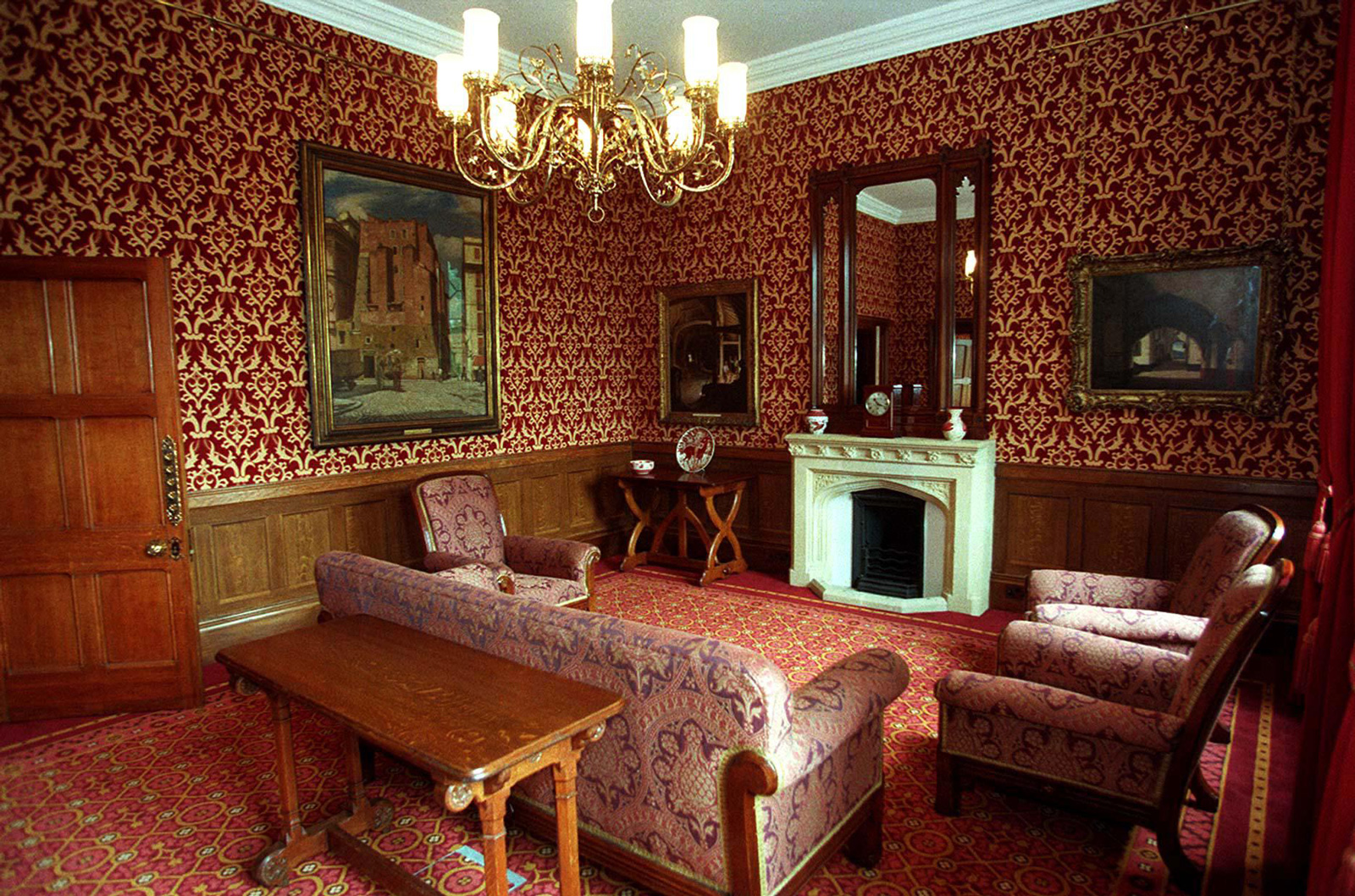
At the other end of the cline: Lord Irvine’s wallpaper. Public outcry at the UK Lord Chancellor’s £650,000 bill, settled by the public purse, for redecorating his official residence in Westminster in 1998, which he excused as a “noble cause,” eventually led to the commuting of a position that had existed for fourteen hundred years. For those who like to own a piece of history, the BBC offered a downloadable desktop version of Lord Irvine’s wallpaper, free to anyone keen to work eyeball-to-eyeball with hideous, tessellating, burgundy-and-acid-yellow Rorschach-like fiends.
To pay the rent on my woodchip aerie, I worked in factories: assembling or packaging food mixers, crisps, chicken pies, nut-topped cakes, frozen desserts, lubricant jelly, talcum powder, bottles of perfume. William Morris envisioned wallpaper as social activism, supplanting cheap industrialization with affordable artisanship—a means of formation of the moral and social health of a nation. How to begin to unpick the failure of that vision?
Repetition is grounding, the basis of tradition and social stability.
Repetition is the engine of difference.
Repetition hones, and is necessary for excellence.
Repetition is dull, dull, dull, dull, dull.
Repetition is dehumanizing, the base state of machines.
Repetition is funny.
—You can say that again.
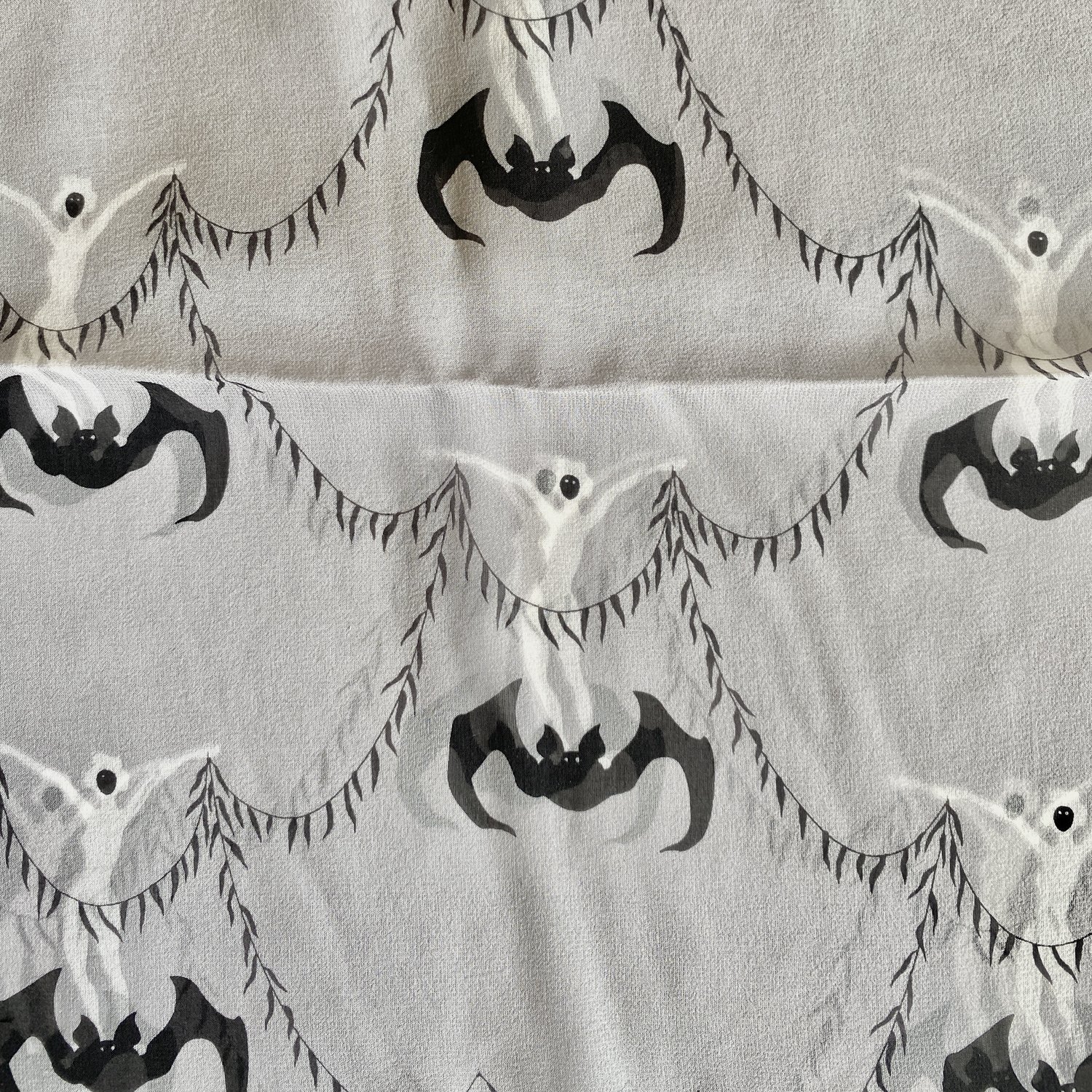
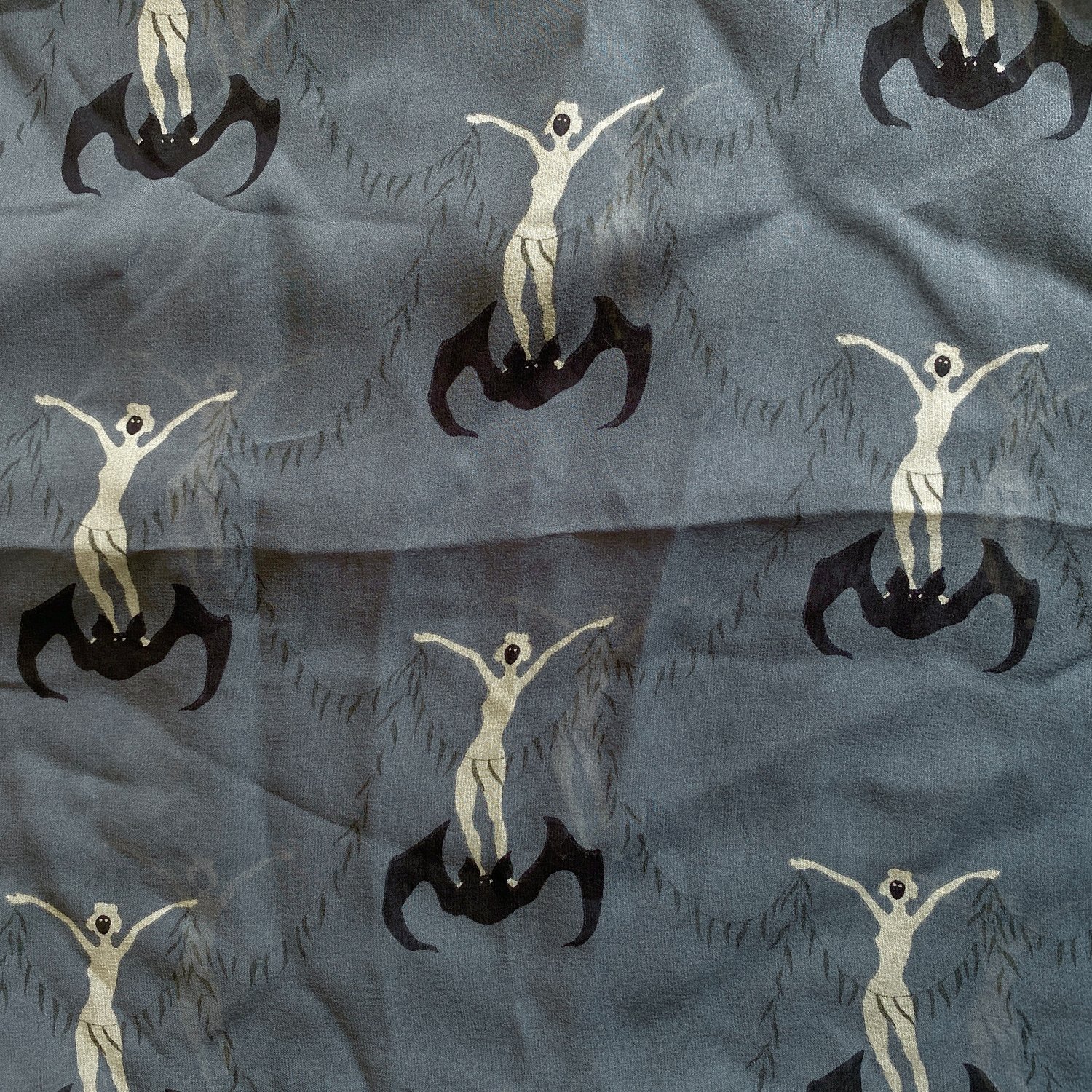
Through repetition, wallpaper is a means within the reach of many by which to pretend toward infinity. Length by length, width by width, repeating designs spool ever outward, architecture permitting. Aiming for ubiquity in the run-up to the 2004 Indian general election, the Bharatiya Janata Party sent voice and text messages to millions of voters, with downloadable election-song ringtones and party-logo wallpaper. Aiming for domestic omnipresence in the late 1990s, ice hockey player Wayne Gretzky produced his own branded pillow cases, breakfast cereal, chocolate bars, and wallpaper. From Edward Gorey’s costume and set design for the 1977 Broadway production of Dracula, the wallpaper in Lucy Seward’s boudoir endured as merch. Pale slender women, naked but for a mask, stand on the back of flying bats; a lattice of creepers festooning hand to hand hold them in immortal, boundless connection. Bat and human eyes—both absences of black ink—pierce a room with their gaze.
Busy wallpaper can turn dangerous. It is populous with monsters, foxes, lions, cowboys, and mold. It is loaded with treacherous substances that enter bodies through lungs: glass-fiber backing; arsenic-laden green paint; 1,1,1-trichloroethane in paste. Napoleon is thought to have died from the green wallpaper in his quarters on the island of St Helena. (Vengeance for its curtailed movement during his wars?) Wallpaper repeats on you. It is infectious. It reaches over the rim of the rational, into the interior. Gilman’s unnamed narrator, prescribed the “rest” cure by her physician husband, is patronized, steeped in tedium, and refused all stimulation—no reading, no writing, no tending to her baby. The nursery’s lurid yellow wallpaper provides unexpected society. A woman creeps behind the sprawling, flamboyant, sickening pattern, shaking it like window bars. In a perplexion of environment and surface, self and other, interiority and world, the narrator scratches off the paper with her bare hands. Had she been confined a century later, she could have used an adaptor for jigsaws or a steam stripper. Had it been a century earlier, the wallpaper tax of 1712–1836 might have saved her from the entire ordeal.
In 1961, the year that Steiner blasted Pollock’s uncommunicative paintings, young Bobby Brewster’s wallpaper came alive (according to H. E. Todd). If Bobby’s encounters with bicycles, conkers, scarecrows, kites, jigsaw puzzles, potatoes, and bees are anything to go by, he and the wallpaper would have had a lively chat. Later that decade, toward the end of his life, Joe Meek—the innovative sound producer and engineer who wrote the song “Telstar” and pioneered such formative techniques as echo, compression, overdubbing, reverb, controlled distortion, and sampling—feared that photographs were trying to communicate with him, that his flat had poltergeists, aliens were controlling his thoughts, and Decca Records, intent on stealing his ideas, had planted microphones behind his wallpaper. A believer in electronic voice phenomena, Meek had tried to capture the voices of the dead in graveyards. When producing records, he used his three-story flat as a studio and instrument, recording musicians in the bedroom, the toilet, on the stairs, each space lending its idiosyncratic acoustic quality to the mix. Might its walls have recorded his own final utterances, and those of his landlady, before they were both killed by his shotgun in disputed circumstances?
However bitter Eisler might have felt about his invention being snatched from him and installed, for good and ill, at the core of the second half of the twentieth century, he continued to innovate right up to the end. Without him, we would lack heated clothes, fish fingers, the rear windscreen defroster, and several other constituents of life’s background thrum. For my part, I now have sway over my own walls. I no longer rent. The mushroom, primrose, and lilac place has been sold off, its capital value dispersed among family members, legal practitioners, the tax office, and the real estate and funerary industries. Its former custodians’ figure-ground relations are preserved: his ashes buried in an urn in a marked plot by a fifteenth-century flint church, hers mingling with the soil of the local woods. My freedom to choose—paint or paper?—feels more of a burden than a liberation. It comes with complicated feelings. I let Iulian, the nine-and-a-half-fingered keyboard-player-turned-panurgic-tradesman, decide. Paper; or paper and paint, he says. Never just paint, but always paper. Because the walls are going to crack. (We live on a hill of clay that is slowly baking in the rising temperatures.) I ask, what about infrared wallpaper? Eighty-odd years on, electrical hot walls are on the table again in this dank northern country that is struggling to meet its ever-loosened green targets. Iulian goes through the motions of laughing, as if I had been attempting to entertain him with lame, quirky imaginings.
Read Sally O’Reilly’s review of Webster’s Timeline History: Wallpaper, 1768–2007 here.
Sally O’Reilly is a writer based in London. Recent projects include the performance collective Big Throw (2024–present), the novella Help in Cucumbers (JOAN Publishing, 2023), and Where They Gather (October House Records, 2022), a spoken-word and music album with Kit Downes. For more information, visit sallyoreilly.org.uk.
Spotted an error? Email us at corrections at cabinetmagazine dot org.
If you’ve enjoyed the free articles that we offer on our site, please consider subscribing to our nonprofit magazine, which includes unlimited access to all our archives.